Portrait of Manuel Tolsá.
painted by Rafael Ximeno y Planes
We posted an article some weeks ago on Manuel Tolsá and the Palacio de la Mineria which he designed in 1797.

Curved vault covers the inner courtyard of the Palacio de la Mineria, supported by a colonnade of double columns toped with Ionic capitels, and surrounded by a balustrade, all emblematic elements of the new Neoclassical style which Manuel Tolsá introduced in the style of Mexico City at the end of the XVIII Century.


Papal Coat of Arms at the
Entrance of the
Guadalupe Chapel.

Papal seal and coat of arms form a keystone
in the doorway entrance of the chapel.

Stairway leading up to upper level
of the Real Palacio de Mineria

The Balustrade of the second floor is of a more simple design than that decorating the roof. The pillared columns on the bottom floor are Doric, while on the second floor the twin columns have Ionic capitels. Why? Variety of design. To become a showroom? Or because of the didactic nature of the Palacio. Originally, it was the "Real Seminario de Mineria", something of a Technological University for students desiring employment in the mining industry. We might bear in mind two things: first and foremost, this Palace was built as a place of learning, and secondly, Tolsá, besides being a great sculptor and a brilliant architect Manuel was a teacher, and the entire building, is a learning experience.
The stone staircase and balustrade in the main courtyard of the Palacio de la Mineria are both palatial and somber at the same time. Although the Palacio de la Mineria is on a much larger scale, the stairway has that solemn feeling of the staircase Michelangelo designed for the Medici family Biblioteca Laurenziana in Florence.

In the 1790's, Mexico City went through an architectural renaissance, thanks in part to the appearance of two giants from Spain, both from Valencia: Manuel Tolsá, of whom we have spoken in the past few months, who took over the chair of Sculpture and Architecture in the Academy of San Carlos in Mexico, and Rafael Ximeno Planes, who was in charge of the school of painting, as the same Academy. His portrait of the miracle of the well of curing waters on the hill of Tepeyac, where the Virgin of Guadalupe appeared to Juan Diego is a milestone both in painting as well as in sociology: a true work of the Enlightment, which maintains completely respectful of the faith and the beliefs of the miracle, but at the same time, takes a hard look at social inequalities present in Mexican Society at the time not only of the Conquest, but 270 years later. The scene shows us Europeans, native Mexicans, and even negro slaves.


Main Altar of Guadalupe Chapel
It is only proper that the Age of Enlightment brought more light. Even on a cloudy day, the Chapel is always full of light thanks to the eyelets at the top of the ceiling Manuel Tolsa designed here.
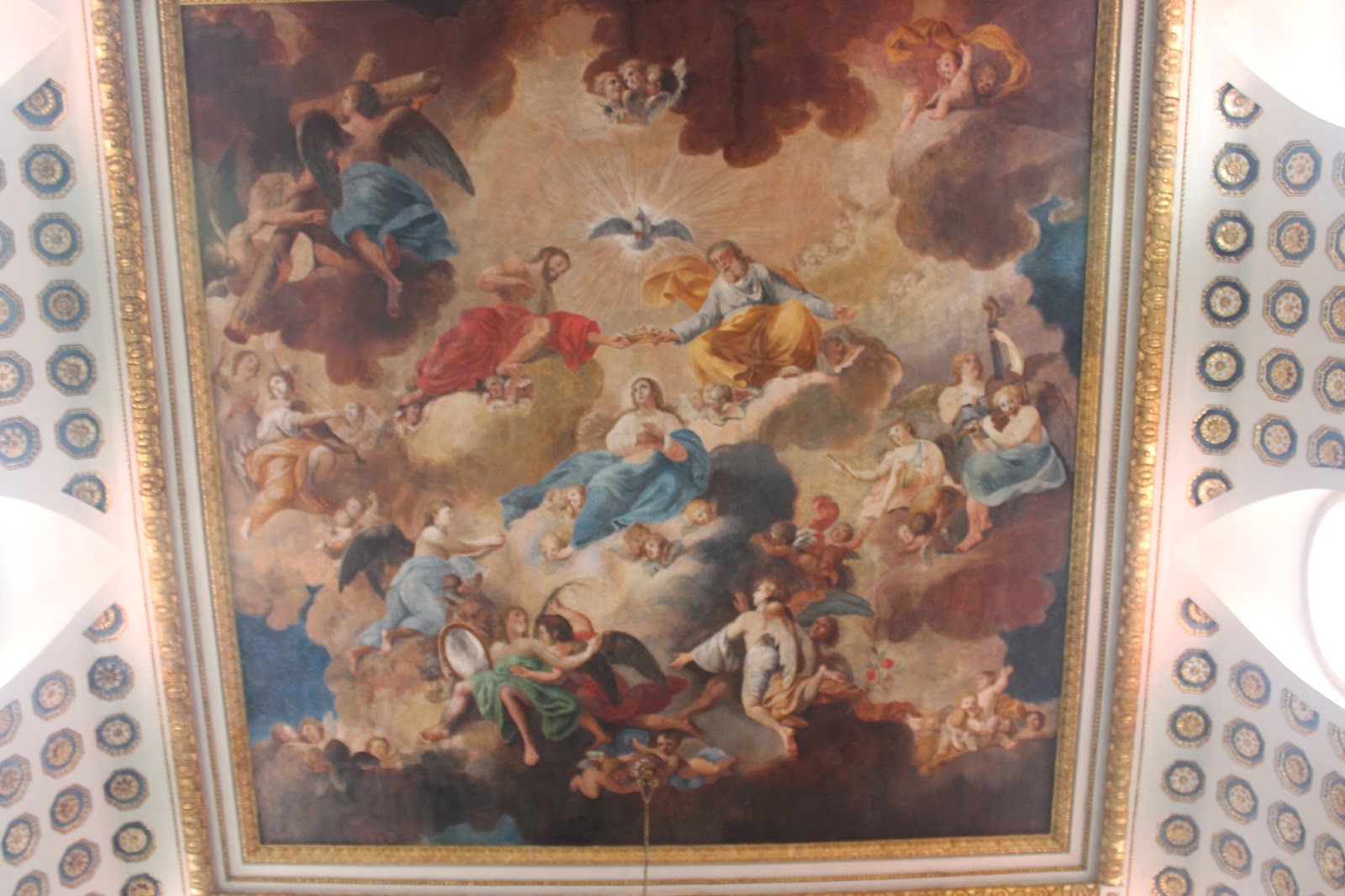
Closer to the front end of the Chapel, we have another matching ceiling painting by Rafael Ximeno Planes, with the Coronation of Our Lady in Heaven, with the Holy Spirit in the top middle, Jesus Christ to Her upper left, and God The Father on the opposite side. Rafael reveals to us a Resurrected Christ, emancipated from the blood and violent scenes so common in the previous period of Baroque Art. The Cross, in the upper left, seems to float, and take on a more spiritual nature here in this art by Rafael Ximeno Planes.

The Virgin of Guadalupe is unique in this chapel. Painted over 250 years later after the miracle of Tepeyac, Rafael Ximeno y Planas gives a reverent but fresh rendering of the apparition. Besides the European-looking angels, there is a darker skinned angel under the feet of the Virgin, Juan Diego, the Mexican to whom the Virgin appeared.

This chapel is something of a oddity. It was finished in 1813, as the War of Independence was in full swing. Many of the outstanding alumni of the Real Seminario de Mineria were involved in the war, and some were eventually hung as conspirators against the Crown of Spain. In less than a half of a century after its completion, President Juarez had the chapel deconsecrated, and it has served as an assembly hall ever since, and Mass is no longer celebrated here.
The Palacio de Mineria started out as a Real Seminario, as such, a Catholic University. Today, it is part of the Engineering School of the UNAM, or National University of Mexico, a lay University. Yet somehow, the chapel, or ex-chapel doesn't feel out of place. The Virgin of Guadalupe, as every good mother, seems quite at home here, trying to keep the Mexican people, her children, together, in harmony, which is a harder task than it might seem. The Virgin of Guadalupe is one of those few common denominators that most Mexicans share.