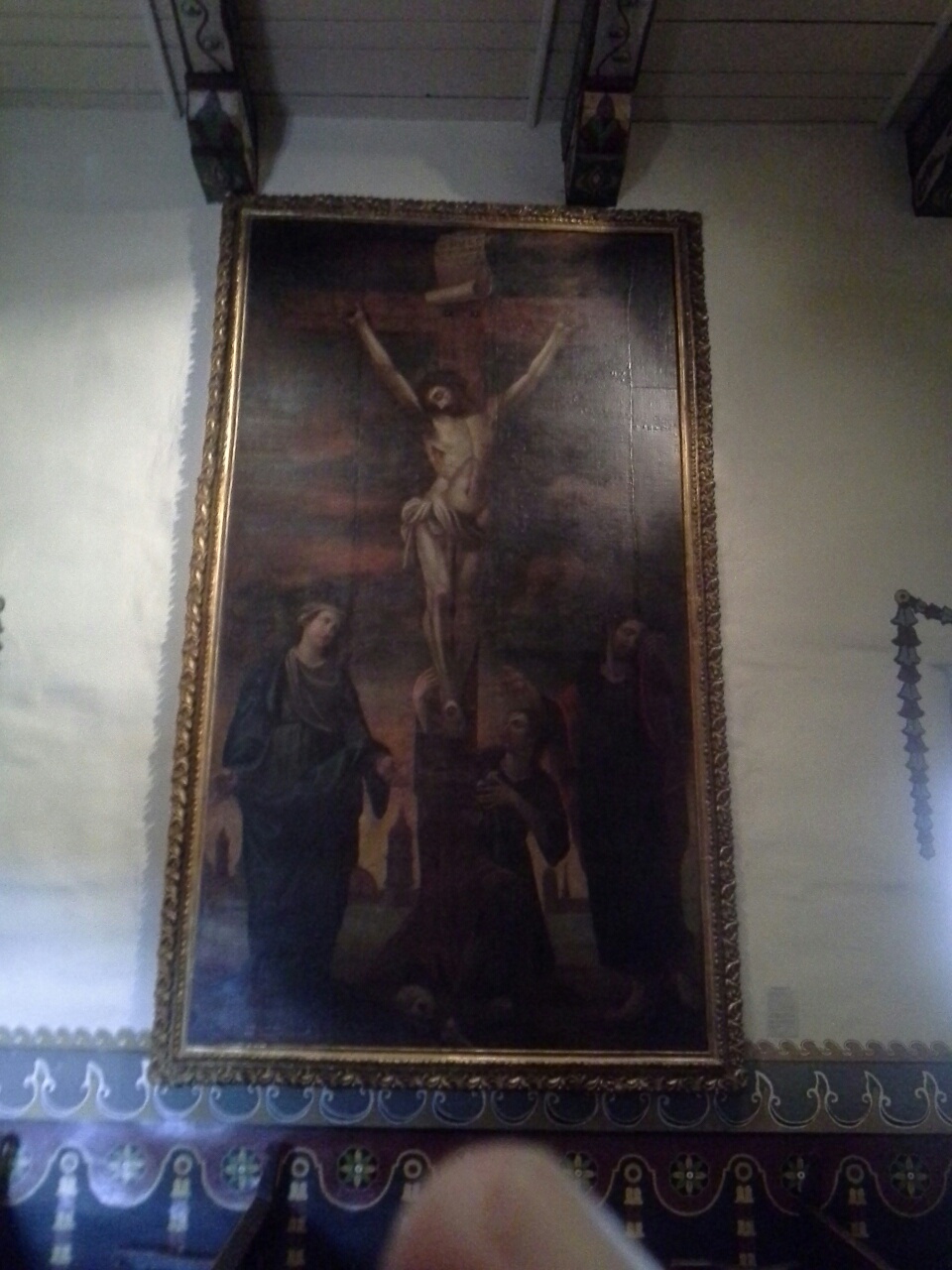
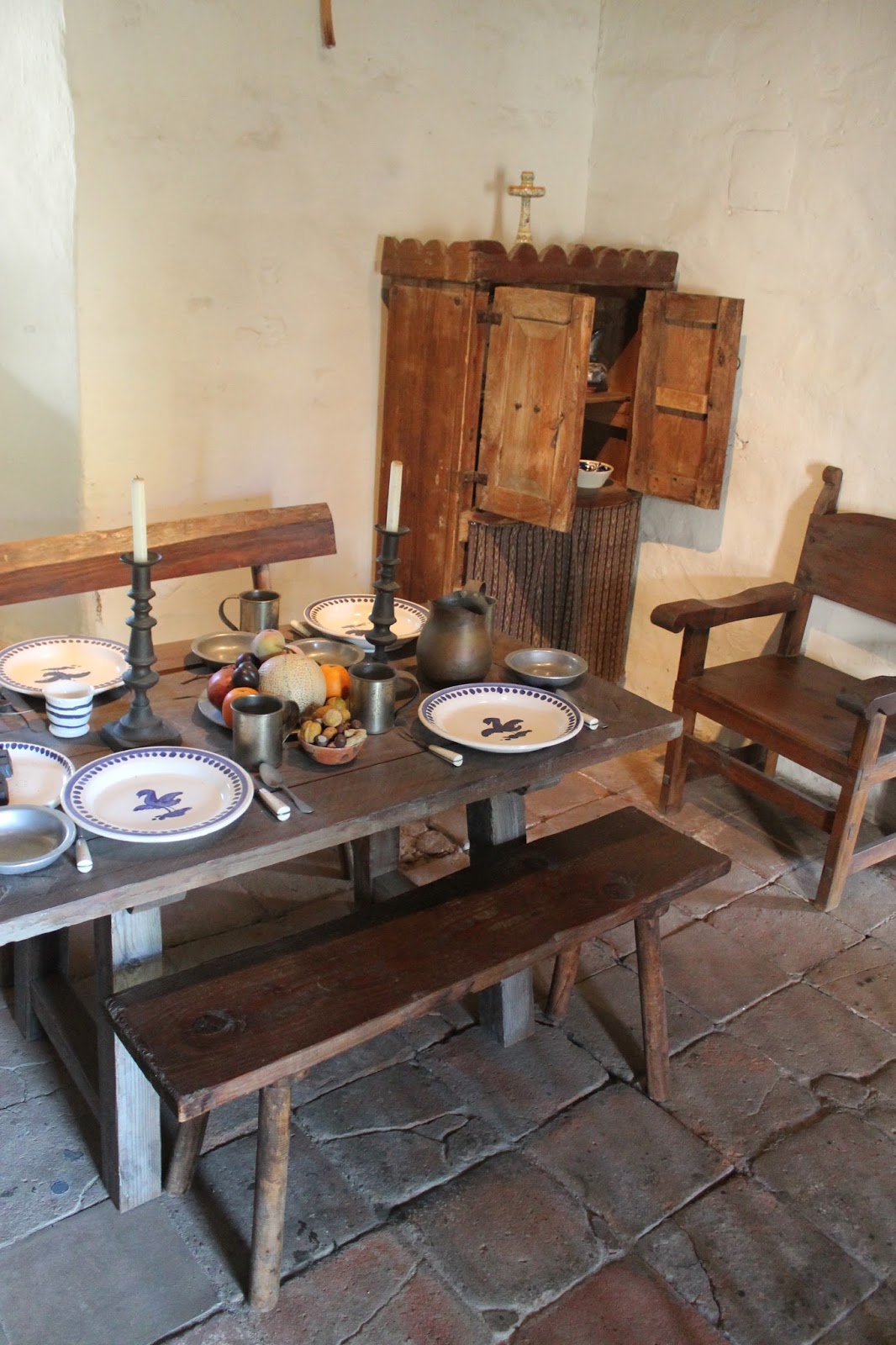
After we left San Diego, driving north, the first Mission we came to was that of San Luis Rey. It was founded by Fray Fermín Lasuén, on June 13th, 1798, the 18th of the 21 Missions established by the Franciscans in Alta California.

San Luis Rey, the Mission on the left, the
Church in the middle and the cemetery on
the right.
After founding the first Mission in Alta or Upper California, San Diego of Alcala Mission, giving the name to the city that would eventually be founded in the southernmost point of California, we could surmise that the next mission would be this one, San Luis Rey, just a few miles up the former Camino Real.

The Mission church has a
right double bell tower with
5 bells. The left tower was
never built, as during the
construction period there
was a major earthquake
causing the bell tower of
the San Juan de Capistrano
Mission to cave into the
main vault, killing many
people in the Church.
This is because our thinking is linear: we think in terms of 1, 2 and 3, then A, B and then C. Yet life is not always linear, nor logical, and such was the case of the Missions established by Fray Junipero Serra.

On the left side of the Mission Church is the
rectangle with a central courtyard, and buildings
on all four sides. The buildings on the front side
have independent quarters on both sides.
Mission San Luis Rey lies on a grassy knoll, 5 kilometers from the Pacific Coast of California. There are sycamores and alders, yet what we saw most were the willows along a mostly dry river bank, while a few noble-looking oaks peered down on us from the surrounding hills.

Juan Rodriguez Cabrillo (1499, Seville, Spain or possibly Portugal-1543, Santa Catalina Island, California), a navigator, who was the first European to sail along the coasts of Southern California, and in early October, 1542, and allegedly came took sight of the San Luis Valley from his ship on his expedition from the Bay of San Miguel (later renamed Bay of San Diego) up as far north as Point Reyes, some 50 miles beyond the Bay of San Francisco, which he apparently missed, due to fog,

Juan Rodriguez Cabrillo remarked on the "Fumos" (or "Humos" as the "smokings" would be called in 21st Century Spanish), referring to the natives system of burning the leftover grass in the fields, a practice still practiced by the agricultural communal or "ejido" throughout Mexico today.

There was probably little agriculture in San Luis Rey before the coming of the Europeans, and although the land is not the most fertile in California, at least it is flat, and good for some types of farming and cattle raising, and enough timber to start building the Mission and its Church.

San Luis Rey was identified an ideal middle point, between two missions that had already been established: to the south, the first Mission, San Diego de Alcala, and to the north, San Juan Capistrano. The natives here spoke the same language as their neighbors north in San Juan Capistrano, so the Franciscans understood them that they would consider converting to Christianity, if they had access to a nearby Mission, which prompted the Missionaries to establish a Mission eventually in this area.

Coming north from San Diego, archaeologists have discovered three different cultures: the San Diegito, from about the year 7,000 BC, followed by La Jolla Culture, before the year 5,000 BC, and the San Luis Complex, which appeared much later.

Sometimes authors and "natural American" groups idealize the life of native Californians. Life was difficult, with decease and violent attacks between tribes not only reducing life expectancy, but at times decimating entire tribes.

The Luisiño Indians as they are sometimes referred had blades, knives, scrapers, made from stone and wood, and later on used milling stones, probably to mill acorns, making them palatable. Around the year 1200 AD, they developed the pottery-making, turning nomadic tribes into a primary civilization.

The religious beliefs of the San Luis natives were described by Fray Geronimo Boscana (1776, Lluchmayor, Mallarca-1831, San Gabriel, California) as a system he termed Chinigchinich, where religious and temporal powers were one and the same, a system that the natives keep with the upmost secrecy,

As the Dieguito Culture gave way to the San Luis Rey period, the organization of food-gathering, food-preparation and food-preservation improved, and with it, the natives health as well. Starvation and scarcity did not disappear altogether, but the cycles became shorter and less devastating.

Fray Juan Crespi left the first Franciscan Mission in Upper California, San Diego, in 1769, traveling north overland towards Monterrey, while Fray Junipero Serra went in the same direction by sea, and a few days after leaving San Diego, their first stop was in this valley, the Valley of San Luis Rey, a valley so verdant, that Fray Juan Crespi said that "it seemed to us to be planted". Juan Crespi noticed that there was plenty of natural pastures for horses and cattle, and grapes grew abundantly, as if they were in a vineyard.

The natives came out to meet Juan Crespi, with body painting typical of Indians about to go to war, but when they were close, they threw down their bows, arrows, lances and knives in an act, which was interpreted by the Spanish soldiers as being friendly and peace-loving. During the following moments, the natives and the Spaniards exchanged gifts, the Spaniards offering them beads and trinkets, and the natives nets made of agave fiber.

This courtyard is used as part of an operative
Franciscan retreat complex for laymen.
However, almost 30 years past by before the Franciscans, on June 13th, 1798, had enough manpower and resources in the region, and the other missions sufficiently consolidated, to start a Mission, which was named in honor of Saint Louis King of France.

One beautiful aspect of San Luis Rey, is that after 200 years, is that this Mission does everyday what it was originally set out for: not a museum, not a interesting but archaic artifact, but a place of prayer, or sacraments, or liturgy, of meditation, where the Franciscans still organize retreats. As they state in their web page: "The Retreat Center is available for private retreats and to individuals who would like a respite for solitude and personal spiritual reflection without participation in a formal program".

When we speak of the founding of Mission San Luis Rey, we can not only rely on account recorder by Fray Juan Crespi. In the case of this Mission, we have the written account of a native, by the name of Pablo Tac, a Luiseño born in San Luis Rey, and later went on to study to Rome, with the intention of eventually becoming a Franciscan Friar.

Pablo Tac not only left us written account of how his people viewed and received the Spaniards and the Franciscans, but something even more valuable: illustrations of what his people looked like and how they dressed.

In 1830, at Mission San Luis Rey, they planted
the first Peruvian Pepper plant, still alive and
growing, the oldest pepper tree in the state of
California
The site for the original Mission was on a hilltop near a village the natives called "Tacayme", although Pablo Tac insisted that the area was named "Quechla" by his people, because of the stone found here. Pablo Tac said that at the time of the founding of this mission, the hill was covered with tress, which the Franciscans ordered cut down for timber to build the Church.

Floor plan of the San Luis Rey Mission, built
around a central atrium or courtyard and the
Church to the right side.
Soldiers and Indians alike helped cut down timber, clear the land and move stones, under the instructions of the Franciscans in the effort to start building the Mission, while specialized workers came up from Mission San Diego Alcala and down from Mission San Juan Capistrano.

The middle aisle of the Mission
Church passes through the main
portico and under a "sottocoro"
arch supporting the chorus.
On the side walls are the 14
"Stations of the Cross" crafted
back in the 18th Century.
The portrait of Our Lady of
Guadalupe was painted by
Jose de Alzibar, the last great
baroque artist of New Spain
The first buildings of the Mission were made of poles and palm leaves, as was the way the natives of this region were accustomed to building. The first buildings of this mission were probably a haphazard chapel and a one room living quarters for the Franciscans.

At the end of the main aisle is the
main altar, flanked by two side
altars: the main altar is dedicated
to San Luis Rey, while the side
altars venerate the parents of the
Blessed Virgin, on one side, and
Saint Joseph on the other side.

The Church transept was covered by a octagonal
dome that is crowned at the top by a wooden
cupola with 144 panes of glass.

Saint Louis, King of France, is
is at the top center of the
altarpiece, accompanied on the
left by the Archangel Saint
Michael and on the right by
the Archangel Raphael, both
are wooden sculptures made in
the mid 18th century.

This side altar to the right of the
main altar features Saint Francis
of Assisi in the middle, flanked
by the Mater Dolorosa (Our
Mother of Sorrows) on the right
by Saint Elizabeth of Hungry.

The left side altar features the
"Ecce Homo", or Christ presented
by Pontius Pilate after His
flagellation and Crowning of
Thorns. Jesus is accompanied
here on the left by Saint Francis
Xavier and on the right by Saint
Diego of Alcala.
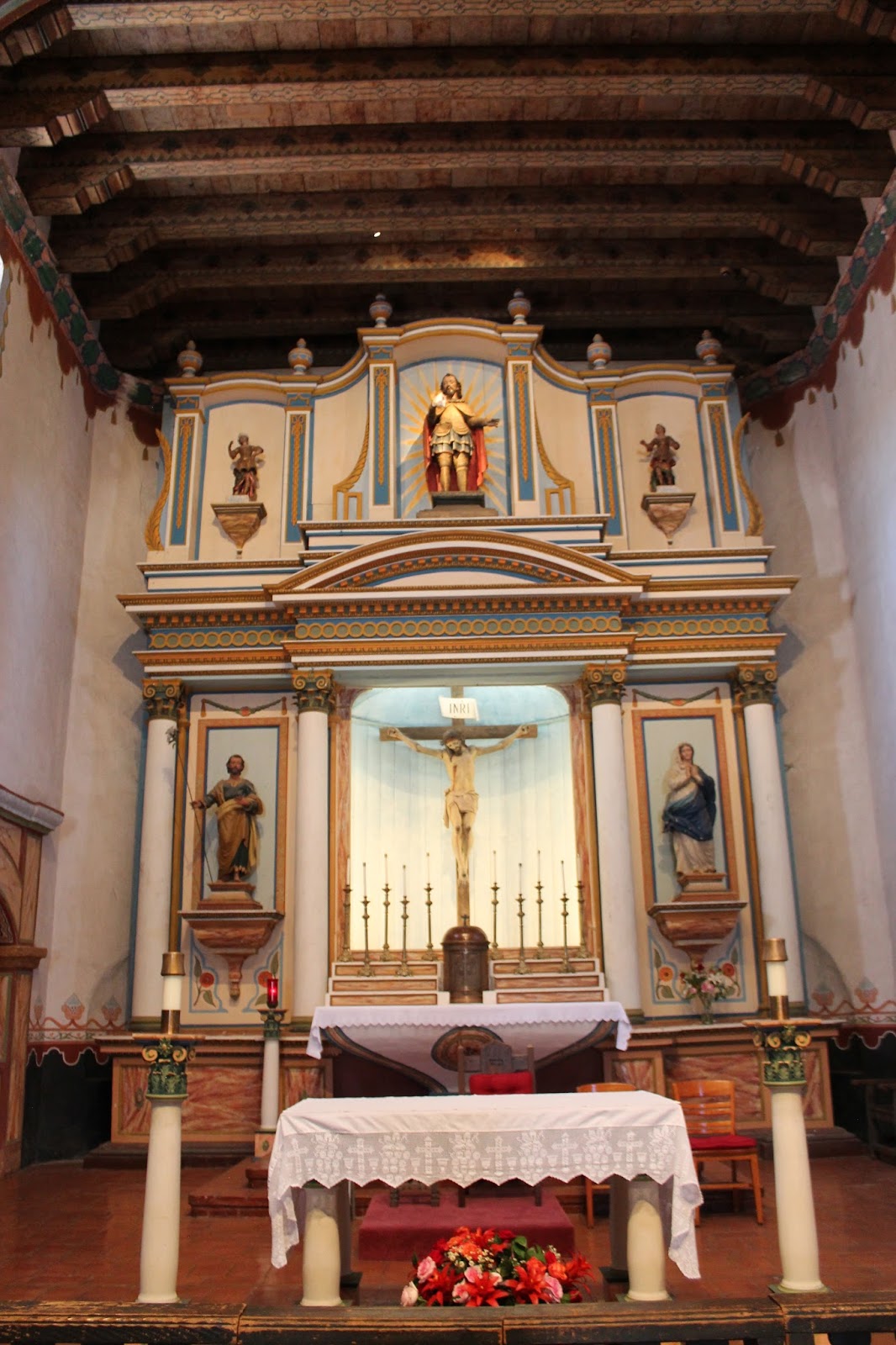
The gilded reredos of the main
altar with a Crucifix in the center
that was crafted in Europe in the
18th Century, and brought by the
Franciscans from Zacatecas.

This view lets us appreciate the
timber ceiling of the main
sanctuary of the Mission church.

The pulpit in the middle of the
Church permitted the priest's
sermon to be heard by all from
the front to the back, in an age
when there was no electric
amplifier or PA system, as the
acoustics are perfect.

The Madonna Chapel features a
statue of the Immaculate
Conception, polychrome wood
carving with a brass crown.

Looking out towards the main
aisle of the Mission Church from
the Madonna Chapel.

This gold and silver monstrance
used for Adoration of the Blessed
Sacrament is in the Mission
Museum

Gregorian Chant with the
Office of Liturgy of the
Blessed Virgin of
Guadalupe


"Alambique" or copper
brandy still.

Wooden doorway of Mexican
style and origin, and a poster of
the "El Zorro" TV series from
the 1950's.

Mission San Luis Rey is located at
4050 Mission Avenue,
Oceanside, California, 92057,
(760) 757-3651