Translate

Sunday, September 25, 2016

The Cloisters, Manhattan ,Ciudad de Nueva York

 The Cloisters is part of the Metropolitan Museum of Art, which has three sites in the city of New York: the first, which is the largest and best known is on Fifth Avenue, in Central Park, while the newest addition is on Madison Avenue, dedicated to contemporary art, while the third is The Cloisters, a project inaugurated in 1938, and strongly financed by John D. Rockefeller Jr., having donated land from his family estate up in Washington Heights district of Manhattan.
 
 
Several abandoned French monasteries, some in a state of ruins since the time of the French Revolution were for sale after the First World War.

 
These monasteries became the core of a collection centered on Medieval Art and bringing back to life in the United States a Museum dedicated to narrating the art and life of Romanesque and Gothic Monasteries, of which Cluny was the most significant model.


Lion from a room above the Chapter House of the
Monastery of San Pedro de Arlanza, Burgos,
Castille-Leon, Spain


Here is the vault of the chapel that was formerly
at Notre Dame du Bourg, at Langon, near Bordeaux

Chapel of Notre Dame du Bourg

Capitals at the top of the pillars

Possibly an effigy of Queen
Eleanor of Aquitaine
 
Three windows offer light for
the altar of the Chapel of
Notre Dame
 

Altar with Crucifix on the top, and two cast iron
candle holders on the side.

The altar has relief carving and tepura painting.
Santa Maria de Ginestarre, near Esterri di Cardos
Lleida, Catalonia,

Notre Dame du Bourg suffered
great abuse and deterioration
during the Thirty Years War
 
 
At many places along the walls
we find reliefs of the Blessed
Virgin with the Infant Jesus

A city in Heaven? The "De civitate Dei"
("City of God") by Augustine of Hippo,
Philosopher, and "Doctor of Church" was a
frequent point of reference in the High Middle
Ages, an ideal to strive for on earth.

 Statue of the Blessed Virgin with
Child (head removed)

Angel from Saint-Lazare at
Autun, Burgundy, Soane-et-Loire
Deep lines give detail to the
feathers of the angel that carries
a musical instrument.

Doors at this time were made of
a composite of wood and iron
brackets, giving it strength and
beauty


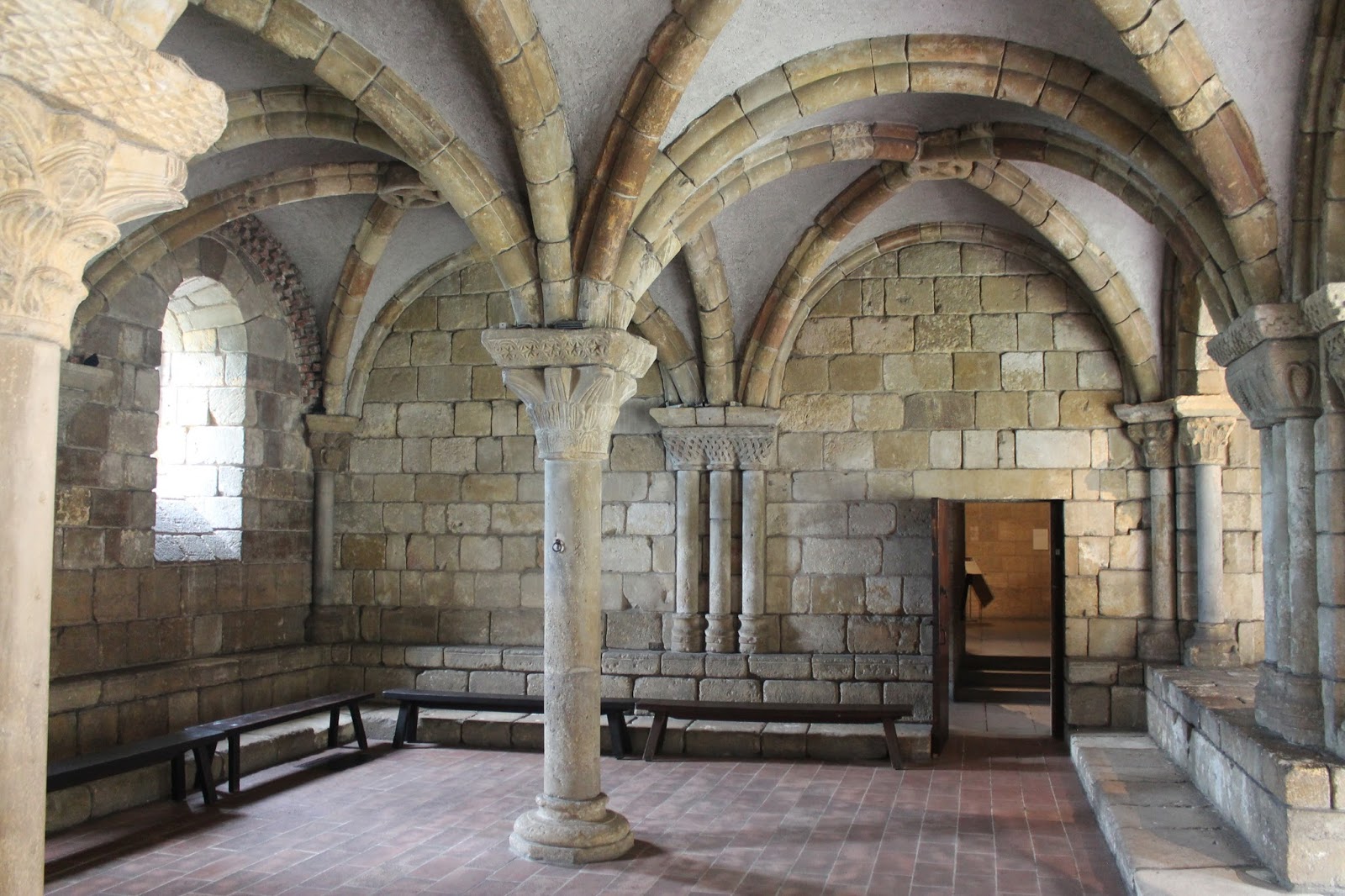
Notice the ribbed vault Gothic ceilings in an
 otherwise Romanesque style chapter room.
 
The chapter room from
Notre-Dame-de-Pontaut, Landes,
Acquitaine, France

The monks would sit around the
Chapter Room on benches.

Notre-Dame-de-Pontaut was built as a
Benedictine Monastery in 1115, but by the middle
of that century, was taken over by the Cistercians.


The Benedictines used their Chapter
 Rooms on Friday Evenings for the
"Chapter of Faults" Exercise.

Many other Religious Orders and
Congregations copied suit and
copied the practice of the
"Chapter of Faults"
.

A novice would kneel down
during the "Chapter of Faults" in
front of the Novice Master, and
giving their back to the rest of
their community.

A mixture of styles as the
Romanic windows lit up a
predominantly Gothic
 construction
  
During the  "Chapter of Fault" a novice would
confess his faults (not sins).

The ring on the column shows
how at one point this Chapter
Room was abandoned and
 converted into a stable.

After the novice finished saying
his faults out loud for all his
fellow novices to hear, they
would respond, one by one, telling
the novice what they considered
to be his faults, so as to correct
them, and become a better
novice, a more "humble" novice.

A unique way of building columns
shown here in the Chapter Room

Animals were common figures on
capitals, especially the Lamb,
representing Christ, "Agnus Dei",
the Lamb of God, "qui tollit
peccata Mundi" ("who takes away
the sins of the World").

The union of the rib vault with a round medallion
representing a flower or a symmetric drawing.

The "Chapter Room" was used on
Holy Thursday for the washing of
the feet liturgy, commemorating
Christ's humble gesture toward
his Apostles before the
Last Supper.
 
The "Chapter Room" opens up
onto a square courtyard.

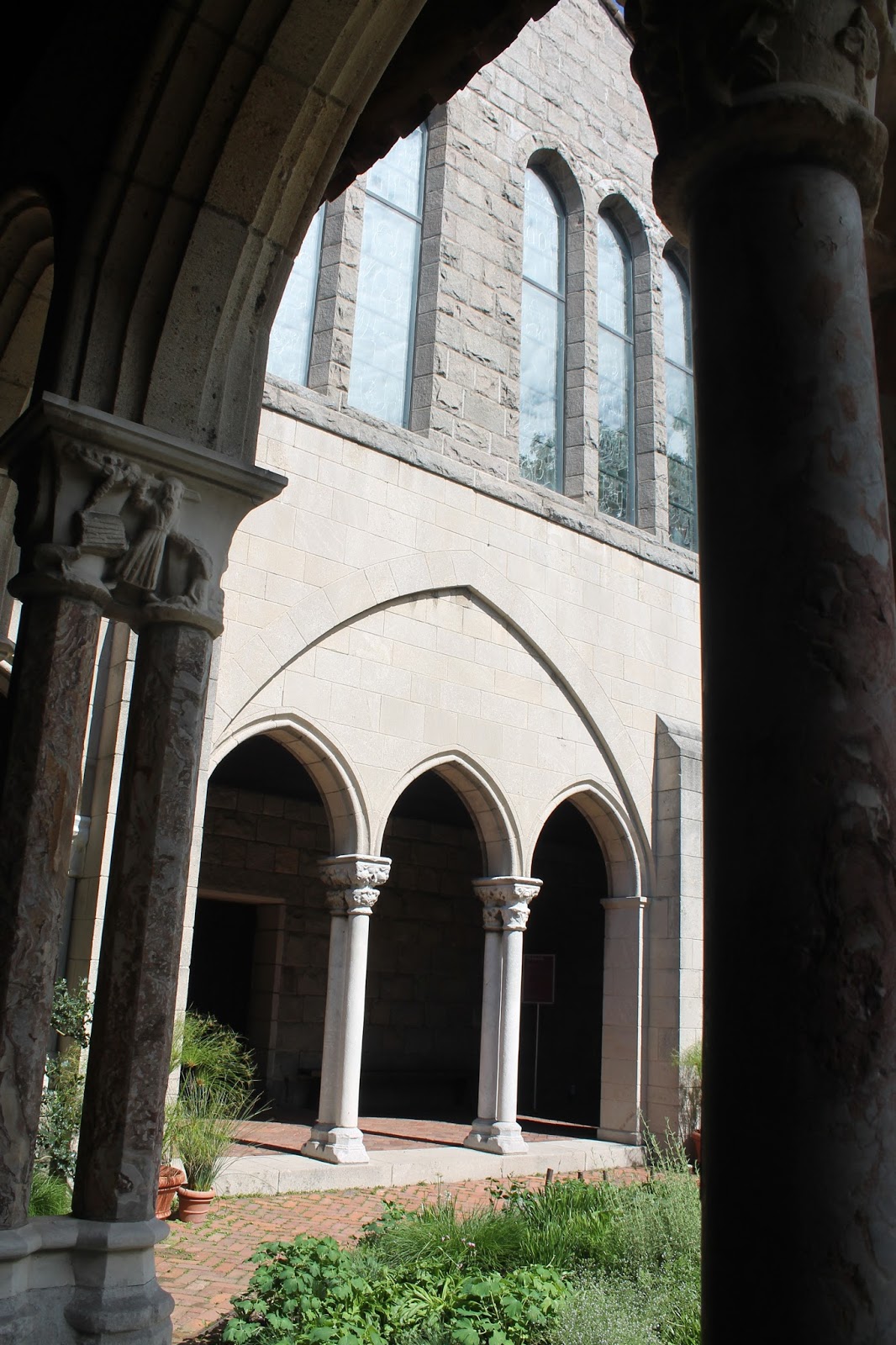
The covered archway surrounding
the courtyard were not only
decorative. They served a function:
offering shelter for the monks as
they walked around, meditating
or praying the Holy Rosary.


The courtyard usually had a central well, fruit
 trees and several herbs for the kitchen and
for the infirmary.


Cloister from Saint Michel du
Cuxa, Catalonia

Saint Michel de Cuxa was a Bendictine Monastery
built from 1130 to 1140 near Perpignon, France


Monks strived to recreate the Classical Roman
and Greek ideals of symmetry in the architecture
and layout of their monasteries.

A crab apple tree in each corner

Each capital has a different motif

Flowers and geometric forms


In the capitals, we find grotesque
demon-like figures, typical of the
medieval period  


In this hall we saw a series of medieval tapestries
on the subject of the Hunt of the Unicorn

The Unicorn is portrayed as a
beautiful and peaceful animal

The Unicorn is a mythical representation of Christ

The Unicorn is mercilessly attacked with lances


Bonnefont Cloister


Trie Cloister


Raphael and Pietro Perugino adorning the National Gallery in Washington

When Estela and I went to the National Gallery in Washington, DC, this month, we went straight for the 2nd floor collection of Italian Renaissance paintings that have gradually made their way here.
 
The "Alba Madonna" (1510) by Raphael
 (1483-1520), a beautiful "tonda" or round
composition.
 
In the middle of one of the rooms, was a "tonda" by Raphael, his "Alba Madonna". But why "Alba"? Raphael painted so many "Madonnas" that we distinguish them by who had them. This specific painting was in the "Duque de Alba" family treasure for years. The Duquesa de Alba just past away last year and left her family fortune, one of the largest in Spain, to a grandchild. As for me, "Duque de Alba" was the brand of fine brandy, aged in oak kegs, that I sipped after dinner with my father-in-law every Sunday as we smoked our cigars.

"Madonna with Child"(1500), Pietro
Perugino (1450-1523)
 
Raphael's works are suitably well accompanied by his fellow countryman from Umbria, Pietro Perugino's Madonna with Child and "Saint Jerome in the Wilderness": painted as a tempera on a poplar panel.

"Saint Jerome in the Wilderness" (1490-1500),
Pietro Perugino (1450-1523)

"The Cowper Madonna" (1505) by Raphael
(1483-1520).
 
"The Niccolini-Cowper Madonna"(1508),
Raphael(1483-1520)
 
"The Holy Family with Angels" (1545-1550)
Dominico Beccafumi (1485-1551)
 
"The Crucifixion with the Virgin, Saint John,
Saint Jerome and Saint Mary Magdalene"
 (1482-1485), Pietro Perugino, (1450-1523)
 
Pietro Perugino's The Crucifixion with the Virgin, Saint John, Saint Jerome and Saint Mary Magdalene by Pietro Perugino is not the original panel, but rather a transfer to canvas.

"Saint George and the Dragon"
(1506), Raphael (1483-1520)

"The Annunciation", a unique pair of medallions painted against a dark background, a masterpiece by Giannicola di Paolo, also a fellow Umbrian, complements the ensemble of the salon.

"The Annunciation" (1510-1515) by Giannicola
 di Paolo (1460-1544)
 
"Flagellation of Christ" (1512-
1515), Bacchiacca (1494-1557) 

"The Gathering of Manna"(1540-
1555), Bacchiacca (1494-1557)

"The Nativity with the Infant Saint John" (1500)
Piero di Cosimo, Florence (1462-1522)


When Estela, my wife, came into this salon, she immediately gave me a shove: "let's take a look at the fishermen portrait!", referring to this bright and moving portrait by Jacobo Bassano.

"The Miraculous Draught of Fishes" (1545),
Jacobo Bassano (1510-1592)
 
I was attracted to the portrait, because the artist is from Bassano, from which the famous Grappa di Bassano comes from, the warming after-dinner drink, which has made this town in the upper Veneto region world-famous.
 
"The Adoration of the Shepherds"
(1535-1540) Jacobo Bassano
(1515-1582)

"The Baptism of Christ" (1535-1540)
Paris Bordone, Venetian, (1500-1570)

"The Adoration of the Shepherds" (1530's)
Giovanni Girolamo Savoldo (1480-1548)

"Doge Alvise Mocenigo and Family before
the Madonna and Child" (1573) Jacopo
Tintoretto (1518-1594)

"The Conversion of Saint Paul"  (1545)
Jacobo Tintoretto (1518-1594)

"Rebecca at the Well" (1580-1585)
Veronese (1528-1588)

"Madonna and Child with Saint
Martina and Saint Agnes" (1597)
 El Greco (1541-1614)

"Madonna and Child"
Sandro Botticelli  (1446-1510)

"The Cricifixion" (1504/1505)
Luca Signorelli (1445/1450-1523)

"Madonna and Child"(1470/1475)
Dominico Ghirlandaio
Florence (1449-1494)

"The Marriage of the Virgin" (1490/1491)
 Luca Signorelli (1445/1450-1523)

"Madonna and Child with a
Pomegranate" (1475-1480)
Lorenzo di Credi
(1457/1459-1536)

"The Adoration of the Magi" (1478-1482)
Sandro Botticelli (1446-1510)
 

"Pieta (The Dead Christ Mourned by
Nicodemus and Two Angels" (1500)
Filippino Lippi (1457-1504)

"Tobias and the Angel"
 (1475-1480)
Filippino Lippi (1457-1504)

"Joseph of Egypt"
 The Griselda Legend

"The Madonna and Child with
Angels and Cherubim"
(1460-1465)
Matteo di Giovanni (1434-1497)

"Madonna with Child with Saints
and Angels" (1513)
Luca Signorelli (1445/1450-1523)

 
"Madonna with Child, Saint
Jerome, Saint Catherine of
Alexandria, and Angels"
(1465-1470)
Matteo di Giovanni
(1434-1497)

"The Agony in the Garden" (1491)
 Benvenuto di Giovanni (1436-1517)

"Christ carries the Cross" (1491)
 Benvenuto di Giovanni (1436-1517)

"The Crucifixion" (1491)
 Benvenuto di Giovanni (1436-1517)

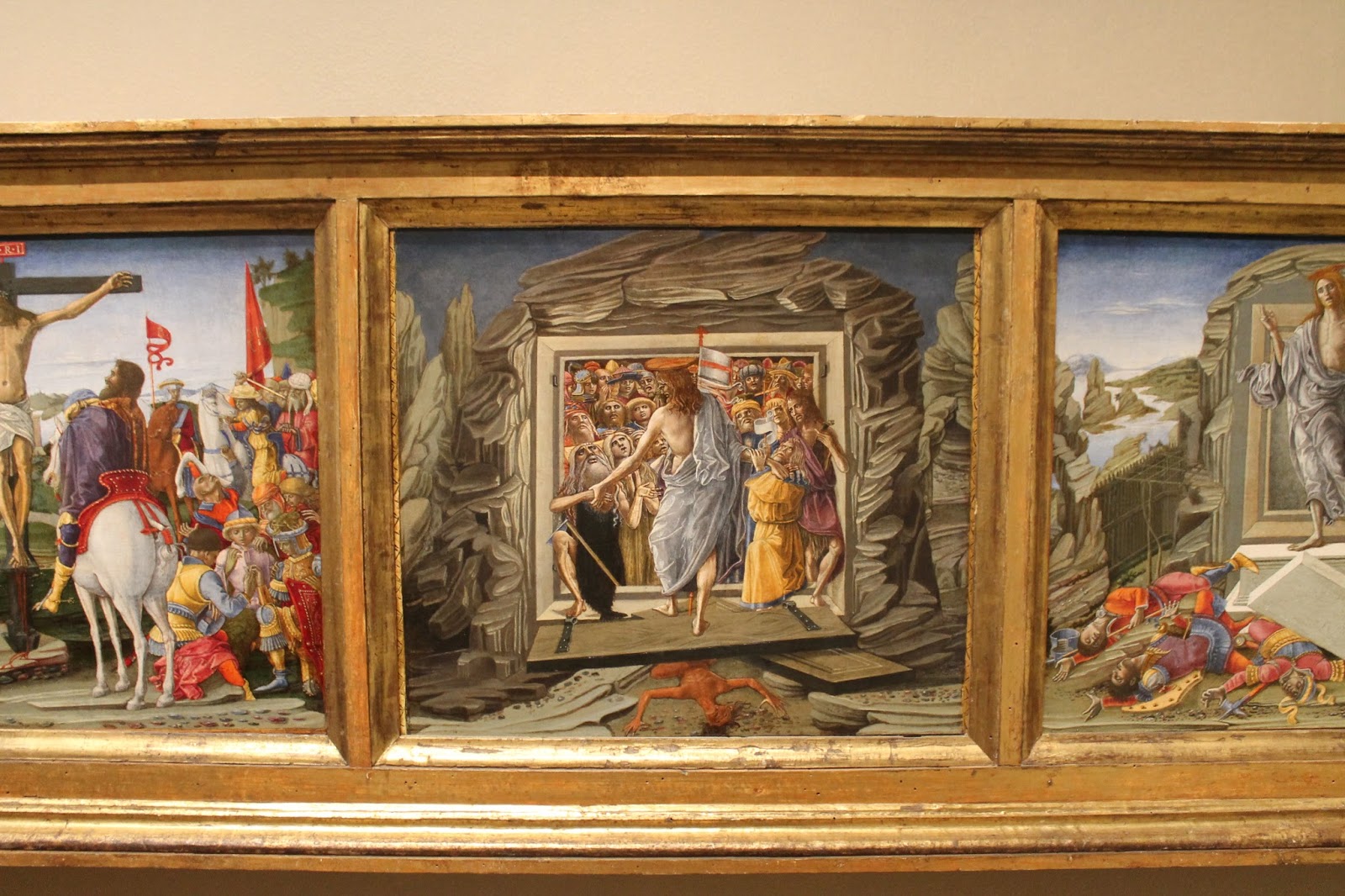
"Christ in Limbo" (1491)
 Benvenuto di Giovanni (1436-1517)

"The Resurrection" (1491)
 Benvenuto di Giovanni (1436-1517)

"The Praedela of  Passion and Resurrection"
(1491)
 Benvenuto di Giovanni (1436-1517)

"The Nativity with God the
Father surrounded by Angels
and Cherubim" (1472)
Francesco di Giorgio Martini
(1439-1501)

"The Holy Family" (1500)
Giorgione (1477/1478-1510)

"The Adoration of the Shepherds" (1505-1510)
Giorgione (1477/1478-1510)

"Saint Jerome rading" (1505)
Giovanni Bellini (1430/35-1516)

"Madonna with Child with Saint Jerome and
Saint John Baptist" (1492-1495)
Cima da Conegliano (1459-1516/1517)

"The Virgin reading" (1505)
Vittore Carpaccio (1465-1526)

"Madonna and Child" (1505/1510)
Vittore Carpaccio (1465-1526)

"Saint Lucy and a Donor" (1580)
 Veronese (1528-1588)

"Saint Jerome" (1610/1614)
El Greco (1541-1614)

Estela passing from one room
to another in the richly
decorated National Gallery