Translate

Sunday, August 14, 2016

Fray Junipero Serra, the great missionary from San Fernando to Jalpan

Where we left off in our previous post, Fray Junipero Serra arrived at the Church of San Fernando, on the morning of January 1st, 1750. The standard procedure here was to retain recruits at this Franciscan Center of Propaganda Fide for two years of missionary training, but in the case of Fray Junipero Serra, his stay lasted a mere 5 months.
 
View of the façade of San Fernando
 
The Missionaries trained at San Fernando were referred to as Fernandinos, and many of the Missionaries that finished their studies here were sent to the Sierra Gorda.
 
The central frieze over the main entrance to the
Church of San Fernando, depicts the saint
 carrying a sword in his right hand and the world
in his left, triumphant over pagans, and
interceding for the souls in purgatory.
 
The Church of San Fernando had only been recently created, yet in the middle of the 18th Century, it was the largest Church in Mexico City.

Here is a side view of what once was the Church
of San Fernando as seen today. The archway in
the middle of the sidewall is the side entrance to
the main altar of the Church. The buildings on
the side seam to camouflage the church, a trend
seen frequently in churches and convents in
Mexico after the 1860 Laws of La Reforma
dictated the expropriation of Church property
(the stores on right hand side are privately
owned).
 
Fray Junipero studied the books in the library of San Fernando, on History, Philosophy, Theology and especially Fray Alonso de la Peña Montenegro's Manual on missionary activity, Itinerario de Paracos de Indios, who asserted that the only way to the Indians heart, and to his conversion, was through "his ears". It was absolutely necessary to learn their language.
 
Carved out of stone, under a seashell,
symbol of purity- Here we find Saint
Francis beholding the Cross of Christ
in his hands, which one day carry
the stigmata, the miraculous sign
of the nails of Christ´s Passion in
the palms of his hands and in
his feet.
 
The Missionary work with the Panes Indians in the Sierra Gorda did not begin with Fray Junipero, and not even with other Franciscans: it was the Augustinians who began the Missions in Jalpan as early as during the second half of the 17th Century.
  
Notice the columns with the zigzag
engraving pattern, popular in the mid
18th Century Baroque style in New
Spain. Here is the Statue of Saint
Dominic on the side of the main
doorway of San Fernando.
 
Before parting from San Fernando, let's talk about its interesting history in the 19th Century. The Chronicler of  Mexico City, Don del Valle Arispe in 1861 wrote: "In 1860, the government (of President Juarez)...suppressed all Monastic orders, and the Convent of San Fernando was abandoned, as well as its beautiful Church. Many took to the task of dismantling and destroying (the retables), not leaving one single painting nor one single book: all the  altars golden altars had been devastated."

Main altar and retablo at the
Church of San Fernando.
 
Yet last week, when I visited San Fernando, I found the main altar Retablo intact, as you can see in the above . This experience moved me to write a rule for pilgrims, like myself, because as pilgrims, we live in a world not only of faith, but of facts: Do not be quick to assume that you are looking is what you believe you are seeing.
 
Christ on the Cross in the top
niche of the Retablo with San
Fernando in the middle box.
 
Yesterday I visited the 18th Century Church of San Fernando in Mexico City. I was admiring the beautiful main altar retablo or altarpiece, similar to those that Miguel Cabrera was making at the same time in Tepotzotlan, less than 25 miles away. The style is the same: churriguresco or late Baroque.
Maria. Mother of Jesus, and her
Immaculate Conception are the
Inspiration of all Franciscan
Missionaries
 
Later I read that the original retablo was damaged in 1858 during an earthquake, and then, a year later, after the seizure of Church property, under the laws of Juarez, desecrated and possibly even chopped up as wood. The retablo I was looking at was actually made in the mid 20th Century, as similar as possible to the original.
 
On the left hand side of the
Retablo of the main altar feature
from top to bottom, Saint Louis
King of France, Saint Francis of
Assisi in the middle and Saint
Anthony  of Padua with the
InfantJesus on the bottom
 
When we visit a church from a certain period, we usually assume that everything we are looking at is original, or from the same period. Churches and convents are similar to living organisms,: they grow, they change, they become old, and at times, die.
 
On the lower right hand box of
the retablo we find Saint Joseph
carrying the Infant Jesus, and
Saint Dominic above them.
 
So fellow pilgrim, you have a choice to make. To be a purist or a realist, when it comes to beholding works of arte sacra from centuries past. The fact is, some of what you see is original, some is restored, some is rebuilt, and some are modern pieces of art, using the style and techniques of another time. In the latter case, I hear sometime the term "a fake" used. I think that this misses the whole point of visiting a church. A work of art is beautiful, it moves us, it inspires us, or it doesn't. The questions of authenticity are secondary.
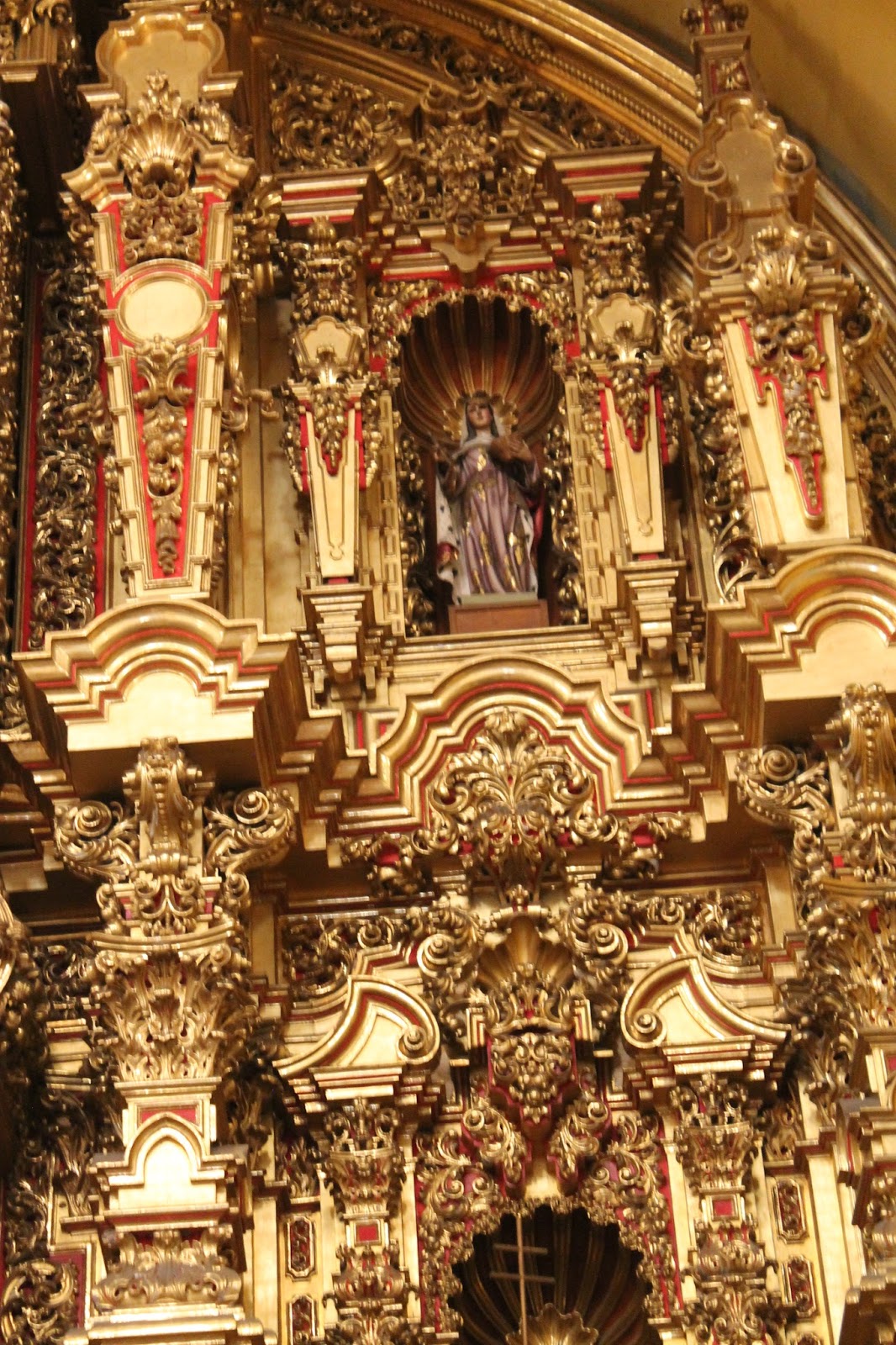
 
The top box of the right side of
the Retablo of the main altar is
 occupied by Saint Elizabeth of
 Hungary, married at 14, widow
at ago 20 and an exemplary
Franciscan tertian, attending
to the sick
  
Coming back to the subject at hand, that is Fray Junipero and the Mission of Jalpan., the objective of the Franciscans and of the Spaniards in the Sierra Gorda when Fray Junipero arrived was to integrate the Panes more into the daily life of Missions, and to have them adopt European agricultural methods, living a life, to use the Franciscan expression, "under the bell".

Nativity Scene on the left wall of San Fernando
 
Fray Junipero had three important allies in this enterprise of the Sierra Gorda: his two Franciscans friars from Mallorca, Francisco Palou and Juan Crespi, and the chief military officer of the zone, assigned to the Sierra Gorda, to extinguish the frequent Indian raids against Jalpan and the other nearby missions, Juan de Escandón.

 
Pulpit from which Fray Junipero Serra
 undoubtedly gave many a sermon in the
Church of San Fernando
 
Fray Junipero was the Missionary that who went the furthest in achieving the goal of civilizing the Panes.
This pulpit is masterpiece of woodcarving
freaturing on the bottom of the panels, from
right to left, great figures of the Franciscan
Order, starting with the"columns of observation"
Blessed Albert of Sarzana, Saint
James of Marches, Saint Bernadino of Siena
and Saint John of Capistrano, with his chest
plate as soldier and defender of Belgrade.
At the base of the fifth column is the effigy
of Fray Pedro de Gant, the great founder
 of la Escuela de los Naturales  (or Natives)
in Mexico City, in the first years after the
Conquest. Pedro de Gant appears there
holding two children, one with a headdress.

The Panes, by their own design, like many other native American ethnic groups indigenous of Northern Mexico, who were all collectively considered "Chichimecas" according to the Aztecs, or to translate the term from Nahuatl, "those who nourish themselves with dog dong" or "dirty sons of dogs", never became a fully integrated people of  New Spain. Few of them went to live in the Mission farms set up by the Franciscans.

Left side entrance to the Church of San
Fernando with the celosia for the members of
the cloister on the top level, and a series of
narrative paintings depicting the spiritual
genealogical tree of the Franciscan Order.
  
Desertion of the Missions was dealt with firmly by Escandón, and the deserters (the Panes) were brought back by force to the Missions and wiped, and if they were found in their native villages, their huts were torched. Escandón and Serra were sure that only if the Panes came to live on the Missions and adopt traditional European agricultural techniques, or to use an expression frequently used by Palou, "living under the Mission bell", were the Panes ever to become part of the social fabric of New Spain.
Statue of Fray Junipero Serra in
the vestibule of the church of
San Fernando, with the Church
in his left hand, and part of
cross (that has been broken off)
 
The Panes were deeply concerned for their own health, welfare and eventual survival. It was common for them to suffer the heaviest when epidemics, mostly of European origin, struck the Missions.

Precarious state of the spandrel
as well as other critical points the
vault, in urgent need of
maintenance, at the Church of
San Fernando, which suffered
even greater damage during the
June 18th, 1858 earthquake

Their diet for the most part was seasonal and more varied than the typical diet of beans, grains, beef and pork, popular with Europeans at that time.

Main dome of San Fernando with star symbol
 of the  Franciscans.
 
The Panes practiced "sembrar en rozas", or "slash-and-burn" agriculture, which the natives around Mexico still practice to this day, and to the great dismay of the local Environmental Authorities that try to dissuade this practice, as it contributes a great deal to the City's air pollution levels, especially during the dry Spring months of March and April.
 

Mary, Queen of Heaven, above the Cross of
Christ on the side walls of the Church of San
Fernando
 
But Escandón and Serra pushed on, and Serra became the chief architect of the new Jalpan Mission Church. The Fernandinos had established five major Missions in the Sierra Gorda:
  • San Miguel de Concá,
  • Santa Maria del Agua de Landa,
  • San Francisco del Valle de Tilaco,
  • Nuestra Señora de la Luz de Tancoyol, beside the jewel of the Sierra Gorda,
  • Jalpan.
This magnificent collage of
canvas paintings give us a great
idea on the spiritual genetic tree
of the Franciscans, their saints
their martyrs and their
missionaries.

In all of these Missions, Serra reorganized the lands and the layout of the towns, and if we can give credit to Fray Francisco Palou's eye-witness accounts, as recorded in his letters, the apostolic work showed phenomenal results. The beautiful churches we see throughout the Sierra Gorda today, are mostly the same as Junipero Serra left them 250 years ago. Junipero preferred stone as the chief material of his churches in the Sierra Gorda, and not adobe brick.

This collage of canvases depicts
San Francisco with his Heavenly
and worldly entourage.
 
But the Panes were not the only problem that Serra had to deal with. Many mestizos and gachupinos (Spaniards born in New Spain), encroached on the Mission lands, in spite of the constant protests of the Franciscans. Mathías de Saldivar was such a case, although initially he helped Escandón control the zone. But as time went by, he even defied the orders of the Viceroy, to respect the Mission lands, and this disobedience earned him his demise, by which he eventually lost all his property. The Crown and its orders were to be respected.
 
Fountains in the Plaza de San Fernando,
once the front atrium of the Church, before
the Expropriation during the Juarez period.
 
As you can see, I have included no pictures of the Sierra Gorda or of the Mission.  It is almost 30 years since I have gone there, and when I went, I didn't take a camera. But I hope to be able to return to Jalpan before the end of the year, or early next year. This time, I will bring a camera, and I will post the pictures I take.
 
Because of the beautiful tombs and monuments,
El Panteon de San Fernando has become a
"must go.to place" for la Fiesta de Los Muertos
on November 2nd, every year.
 
Fray Junípero Serra and Fray Francisco Palou ended their days in the Sierra Gorda Missions in 1758. During the next 10 years, they would spend most of their time in San Fernando, preparing Missions and preparing young Missionaries.

Many people living in Mexico City nowadays are
more familiar with the Panteon de San Fernando
(the cemetery) more than with the Church, as
many of Mexico's most important political
figures of the 19th century, including the wife of
President Benito Juarez (her tomb in this
picture) were buried here.

Then something very unsuspected happened. The Jesuits, who had created missions throughout Northern Mexico, were banished in 1767 from Spain and New Spain by King Carlos III. The crown decided that the Franciscans, Augustinians and Dominicans, as well as the secular clergy could take over their institutions and missions. At first, the Ferdinandos were Galvez in 1768  to take over the abandoned Missions of the Jesuits in Baja California, and both and Palou were assigned to them. Yet as time went on, they realized that Baja California was too scarcely populated to sustain feasible Missions. On March 28th, 1769, a 65 year old Franciscan, with a chronically handicapped leg, set out to walk overland to San Diego Bay, where he would be met with supplies by two vessels.

After the Expropriation of San
Fernando during the presidential
period of Benito Juarez, the Church
cemetery, used up until that period
for the burial of Franciscans and
their benefactors, was destined as a
 memorial for the most important
heroes of Mexico. Here is the
tomb of Mexico's Independence
War Heroic General and later
President who abolished slavery 
 
Fray Junipero would arrive on June 29th to San Diego, and as he approached the bay, he was happy to see the San Antonio and the San Carlos, the two Spanish ships awaiting them there. From here, Fray Junipero would set off to establish the Mission of Monterey, and the other missions of the Alta California.
 
Estela is in one of several courtyards
in what once was the San Fernando
compound.
 
My articles of the next few days will deal with the two presidios and the six missions set up by Fray Junipero or by Fray Francisco Palou or by Fray Crespi during the following 15 years.

This bridge over the San Juan River in the town
of San Juan del Rio, in the State of Querétaro,
 built in 1711 by Pedro de Arrieta, master
architect of the Cathedral of Mexico City and the
 Basilica of Guadalupe was part only entrance
to the town at the time of Fray Junípero Serra
 
The work and dreams of those three Franciscans and their Ferdinandos gave a personality to California, that still remains, in its architecture, its love of natureand its spirit of indomitable enthusiasm: "Siempre adelante", "Always ahead", the motto of Fray Junipero, up to his dying day in the Mission of San Carlos Borromeo, in Carmel, California.

Monday, August 8, 2016

Fray Junipero Serra, getting ready for the Sierra Gorda Missions.

Miquel Joseph Serra (Fray Junipero Serra's baptismal name) was born in 1713  in Mallorca, an island in the Mediterranean, belonging to Spain, famous for its luxurious resort, Palma de Mallorca.
 
Statue of Fray Junipero Serra, Qeretaro

But Junipero Serra was not born in the cosmopolitan port of Palma, but in the small (less than 500 households) arid mountain village of Petra. Antonio Nadal Serra, Fray Junierpo's father, had a small farm near their home in the village, but also worked some lands that were not outright his property, but were over hour away, and he had to take his mule there to till the land, paying taxes, in good years and in bad. And at the beginning of the 18th Century, there were more bad years than good.

Bad harvest in 1702 and 1703. Grain harvests suffered in 1710 when rains came too late. More bad harvest, back-to-back between 1711 and 1712. Fray Junipero parents, Antonio and Margarita, shared another tragedy: their first and second children died. Then there was the War of Spanish Succession, forcing immigration from Sardinia to Mallorca.  For centuries, the people of Mallorca enjoyed home-rule, but starting with the Bourbon monarchs in Spain, government became more centralized. These were hard times in Mallorca. Antonio, Margarita, and their children, Miquel Joseph and his little sister, Juana Maria were not the poorest, but their lifestyle was without luxuries. This ambience formed Miquel Joseph character and determination. Their home had two bedrooms, one for the parents and Miquel and his sister shared the other. The mule slept indoors on the bottom floor, along with the hay and the cart.

The Serras owned a cart much like this one we
found at the Mission of Santa Barbara

Joseph Miquel started studies early at the Franciscan Convento de San Bernandino in Petra, in sharp contrast of his parents who could neither read nor write. Here the future Fray Junípero became adroit in Catholic Doctrine, Catechism, prayers and Latin, as well as reading and writing in Spanish.

At age 16, in 1730, Joseph Miquel left Petra and the Barracar , as he was invited to the Novitiate of San Francisco de Assisi in Palma thanks to his excellent student track at the Convento de San Bernadino, especially in Latin and Gregorian Chant, and from that point on his life would become more tightly tied with the Franciscans and with the Catholic Church more than with his homeland and with his family.
 
At the Mission of Santa Iñez that Fray
Junipero founded, we found this
lectern with Gregorian Chant such
as he learned to sing as a student
at the Convento de San Bernadino

Palma was home to one of Spain's largest and most beautiful Cathedrals, built on the ruins an ancient mosque, with 12 lateral chapels. Besides the Cathedral, Palma had 5 major parishes and another 41 churches.

In September 1730, Miquel Joseph entered the Novitiate of the San Francisco, and started on to a life of prayer, silence, study, reflection, prayer and bodily mortification, in an effort to imitate the Passion of Christ.

Role model for Miquel Joseph at this point of  his life, were three Spanish Missionaries: Fray Antonio Llinás, Saint Francis Solano and Padre Antonio Margil de Jesús.

Antonio Llinás was born in Mallorca in 1635, in a village in Mallorca, nor more than 20 miles from Palma, and like Fray Junipero, entered into the Franciscan Order. He was recruited as a Missionary, destined for New Spain in 1664, in different friaries in Querétaro, northwest of Mexico City. Antonio Llinás later returned to Spain, and convinced his superior general to allow him to recruit a group of 27 young Spanish Franciscans, and to establish the Apostolic College of the Santa Cruz, in Querétaro. From here, Antonio Llinás started his missionary activity in the Serra Gorda. Important point here: many believed that Fray Junipero Serra initiated the Sierra Gorda Missions. This is not true. Fray Junipero Serra however became the most successful Missionary leader in the Sierra Gorda Missions.
The bell tower and entrance
to the Templo de la Santa
Cruz de Querétaro, the
formation center of
Franciscans destined to
work at the Sierra Gorda
 Missions, founded by
San Francisco Solano.

When Miquel Joseph was 13 and still studying at the Convento de San Bernadino, he was deeply impressed by the Canonization of Saint Francis Solano. Francisco Solano was born in Spain in 1549. but after a life full of success, at 40 he parted for Peru, where he dedicated himself to converting en masse thousands of Peruvian Indians. Fray Diego de Córdova Salinas wrote that the life of San Francisco Solano "from the time God called him to religion, was a continuous martyrdom of penance, self-mortification, fasts and afflictions against his body".

Padre Antonio Margil was born in Valencia in 1657, and became one of those Franciscan Missionaries that Saint Francis Solano had recruited for his missionary work in Querétaro and in the Sierra Gorda. But Padre Antonio Margil had done "misiones" or popular retreats in Mallorca a generation before Miquel Joseph and many of his teachers probably had some type of contact with Padre Margil. Padre Margil eventually became a missionary legend, covering areas from Texas to Louisiana, and from Querétaro to Costa Rica. Likewise, Padre Antonio Margil brutally mistreated his  body with hair shirts and an iron "disciplina", to insure his purity and to ward off temptation.

After finishing up his year of novitiate, Miquel Joseph picked a name for himself for his profession of vows: Junípero, one of Saint Francis Assisi first disciples, a fun-loving friar, known as well for his pranks. Yet few Franciscans ever understood the mystic of simplicity better than Fray Junipero. In December, 1737, at 24, Fray Junipero Serra was ordained a priest.

Over the next 12 years, Fray Junípero Serra would spend most of his time as an outstanding professor of Philosophy and Theology. Yet at times, he would also work on giving "misiones" or something similar to a "revival" in different parts of the island of Mallorca. As Fray Junípero matured, this life became too comfortable.

In 1749 he went back to Petra to bid farewell to his parents and to his sister, Juana Maria, who at this point was married and with several children. Shortly after this last trip home, Fray Junípero took a ship to Cadiz, where he spent sometime waiting for a ship to take him off to Puerto Rico.

This first leg of his voyage to America was not completely uneventful. Much of the sea traffic in the mid 18th Century between Mallorca and Cadiz was carried out on English vessels, and Fray Junípero's trip was not an exception, but almost an abortion. The captain of the vessel was Protestant, and deeply devoted to the study of scriptures, and highly skeptical  of Catholics. Fray Junípero had never had direct personal contact with a protestant, and was highly argumentive during the entire voyage, and at certain moments, very disrespectful of the captain's authority. This encounter might have seemed comical at moments, especially with all the arguments through a translator, but Fray Junípero was close to being lowered from the vessel before arriving to Cadiz.


In Cadiz, as was the case of all the Spanish Missionaries awaiting a ship to take them to New Spain, Fray Junípero had to wait several weeks. The night before his ship left, he wrote a letter to be sent back to his sister and to his parents, telling them that he was leaving for New Spain, and that he would probably never see them again in this life.

After a long stormy crossing, Fray Junipero's ship finally landed in Puerto Rico. However, just as in Cadiz, a long stopover was waiting for him here also. He used this period to become involved in local "misiones" on the island. His rhetoric was well structured and elegant, and full of syllogisms, typical of a university professor of philosophy. However, he realized that this line of discourse only bored his audience in Puerto Rico. But Fray Junipero learned a lesson from this failure, and changed his style of preaching, a lesson that would help him enormously later on in the Sierra Gorda.

On the final leg of his trip, the Guadalupe was taking in water as it neared the Mexican port of Veracruz. Then a storm blew the Guadalupe out to sea. The entire group of Franciscans on board each wrote on a slip of paper the name of their favorite saint, whom they asked to help save the Guadalupe. Fray Junipero invoked San Francisco Solano. But it was Santa Barbara, on her feast day in early December, that saved the Guadalupe.

The old fort at the Port of Veracruz
 
From Veracruz to Mexico City, Fray Junipero Serra was bitten by an insect that left a lasting sore on his leg, that would plague him during his journeys for the rest of his life.
 
Fray Junipero Serra arrived
to the Villa de Guadalupe
on December 31st, 1749
 
On January 1st, 1750, early in the
morning, before sunrise, Fray
Junipero arrived at his first
residence in New Spain,
 the College of San Fernando

Friday, August 5, 2016

How my family and I discovered Fray Junipero Serra.

Over 30 years ago, when my children were coming of age, Estela and I picked a school for them here in Mexico City called the "Colegio Junipero". but we didn't have the slightest idea why it was called "Junipero". I even thought it was named after the "Juniper tree".

Statue of Fray Junipero at
dawn at the Plaza de la
Crececita., Querétaro City
 
We picked the Junipero because it had a hybrid educational program: 8:00 to 1:00 in which they followed the parochial academic program of California's Catholic schools in English, and from 1:00 to 3:00 with the official Mexican educational program in Spanish.

The Church of the Santa
Cruz, Queretaro City,
once part of the Franciscan
Mission where Fray Junipero
spent time preparing his
trips.
 
This wonderful grammar school where my children went, was under the direction of a Franciscan nun, Sister Ellen, from California.

The main altar of the Church of the Santa Cruz in
Querétaro has the original stone cross that
miraculously appeared to the Chichimecas when
they lost the battle to the Spanish troops during
the Conquest of the City in the 16th Century
 
 There was a church beside the school, "Saint Patrick's Church", where the children of the Colegio Junipero attended Mass. "Saint Patrick's Church" was very colonial-Californian in style, with its terra-cotta tiled roof, whitewashed walls, and central portico with arched-covered pathways enclosing the atrium on several sides.

At this little chapel outside
the Church of the of the
Santa Cruz is packed full
every morning for
7:00 am Mass.
 
 
My children loved going to Mass at Saint Patrick's, because after services, they were treated to a very uniquely Catholic-American tradition in the church hall: "Coffee and Doughnuts" (although the coffee was obviously for the adults only, the children had doughnuts with fruit juice).


To avoid the children wasting a big whole half-eaten doughnut, instead of regular circular doughnuts, the church gave the children the "hole in the center" small round doughnut, easier for the children to hold and eat.

At the chapel of the Santa Cruz, the small but
beautiful altar.
 
Not being a native born Mexican, I was always fascinated by traveling with my children to every possible part of the country.

The chapel at the Fort of the San Blas.

In the late-1980's, our r children were 9, 8, 4 and 2 years old, I took them to a small remote beach town out on the Pacific Coast of Nayarit: the abandoned port of San Blas, an important stop-off harbor during the 16th and 17th centuries for the Nao de China, the trade route from China to the Philippines, that ended in the port of Acapulco.

The route of the Nao de China (taken from an
illustration provided by the Museo Nacional del
Virreinato, Conaculta, INAH, México)

After spending the entire morning at the beach at San Blas, I took my children up to an old abandoned fort, with cannons. San Blas had a reputation among English pirates such as Drake and Cavendish as a port with weak defenses against siege, attack and eventual pilferage, so the Spanish had to build the fort overlooking the San Blas bay.

My children and I exploring
the ruins of the abandoned
fort of San Blas.

Inside the fort, my children made a discovery: a statue of Fray Junípero Serra. "Look Dad, here is the Fray Junipero our school is named after!", they told me. At this point I realized that their school was named after an 18th-century Franciscan Missionary, and not after a tree.

The pastor of the parish church of San Blas, told
them the story of how Fray Junipero taught the
people of San Blas how to become good Christians
 
Although Henry Wadsworth Longfellow never came here, he wrote a poem entitled  The Bells of San Blas, giving this old port a melancholic but accurate description:
 
They are a voice of the Past, 
Of an age that is fading fast, 
Of a power austere and grand; 
When the flag of Spain unfurled Its folds o'er this western world, 
And the Priest was lord of the land.


The chapel that once looked down 
On the little seaport town 
Has crumbled into the dust; 
And on oaken beams below
The bells swing to and fro, 
And are green with mould and rust.
 
As my children got older, they received school assignments about Junipero Serra. Initially we found out that he was very much attached to the Missions of Querétaro, of the Sierra Gorda, of which today the most beautiful extant churches are those in the villages of Jalpan, and in the smaller village of Concá. One early morning in the late 1980's, I traveled to a paper mill on the edge of this region, and after my business meeting, I drove over to Tequisquiapan, to take a cup of coffee.

Estela standing by the town
square's central fountain at
Tequisquiapan.

Walking around Tequisquiapan, I entered into a Tourism information office, and a gentleman at the desk gave me an introduction to the Sierra Gorda, and the Missionary Route of Fray Junipero Serra. I was encouraged to drive over to Jalpan, and not to miss nearby Concá.
 
My business appointment that morning at the paper mill had been such a sour experience, that I whimsically and somewhat irresponsibly took off on a drive by myself to visit Jalpan and Conca. My first stop, 98 miles (162 Kilometers) was Jalpan, a three hour drive. I was overwhelmed by the beautiful baroque façade of the Mission Church. I knocked on the door of the parish, and asked for the pastor. I cannot remember his name, but he spent a good part of his afternoon explaining the history of Jalpan and of the Sierra Gorda, and likewise encouraged me not to miss the Mission church of Conca.
 
After a 40 minute drive, some 20 miles north (33 kilometers) of Jalpan, was the small town of Arroyo Seco, where the Conca Mission is located. It was dark by the time I reached Concá. Since my conversation with the gentleman at the desk at the Tourism office at Tequisquiapan, I had felt enchanted the entire day, as I felt pulled towards the Missions of the Sierra Gorda. In what was a full day since breakfast that I hadn't called my wife, I finally found a place to spend the night in Concá, a series of bungalows with a stream going through the garden, I called home and told her I wouldn't be able to make it home until the following day. Afterward, I walked back from my hotel to the Misión Concá and looked at its beautiful façade in the moonlight.

As you study Baroque Art in Mexico from the period of New Spain, especially, that created during the 18th Century, you realize where the European influence ends, and the native Mexican artistic creativeness and style takes up. I have seen it hundreds of times, but never as evidently and as beautifully as on the moonlight façade at Concá.

Catholics profess a Creed by which we claim we believe in the Communion of Saints. I have never questioned that belief, but I sometimes believes it involves a great deal more than meets eye. Perhaps
the Saints can intercede to God on our behalf. If there is any truth to this, maybe it might be that I feel a certain fellowship with certain saints and martyrs. I believe this may be my case and Fray Junipero Serra.


Wednesday, August 3, 2016

Following in the footsteps of Fray Junipero Serra: Missions in Alta California

As early as the 16th Century, Fortún Jiménez, a pilot under orders of Hernán Cortes, claimed California in 1533, but for the next 160 years, no serious attempt was made by Spain or any European power to settle the area. Between 1697 and 1767, the Jesuits established 17 missions in what we now call Baja California (which belongs today to Mexico), starting from south to north, the Mission of San Jose del Cabo up to the Mission of San Francisco Borja.
 
18th Century map showing the first
 Jesuit Mission on the southern part
of the peninsula of Baja California
and the later Franciscan Missions
founded by Fray Junipero Serrra. 
(map belongs to the Mission of San
Carlos Borromeo, Carmel, California)
 
Fray Junípero Serra (1713-1784), a Franciscan Missionary priest born in Mallorca, is considered by the majority of residents of the State of California as the most important person in the discovery and early settlement of their territory, while the Catholic Church honors his efforts in setting up a network of 21 Missions and Presidios in the Alta California (as it was known at that time), starting south at the Mission of San Diego, and working northward, as far as the Mission of San Francisco Solano, at Sonoma, in the Napa Valley, some 50 miles north of San Francisco.
 
Statue of Fray Junipero Serra
in front of the façade of the
Mission Church of San Carlos
Borromeo, Carmel, California
 
Some of the followers of this blog might remember that two years ago, on July 19th, 2014, that we wrote the first of two articles (in Spanish) on the Mission of San Juan Capistrano. (If you are viewing this blog now from your desktop or laptop computer, you will see a new feature in the right hand column, entitled "Featured Post", a new development by "Blogger", and permits you to easily refer to a previous article or "post".)
 
Resting at a fountain with the Mission Bells in
 the background at San Juan Capistrano,
California.
 
That experience two years ago of visiting a Franciscan Mission in California left an indelible mark in our hearts and souls, and left us longing to organize a much larger pilgrimage last month (July, 2016), visiting 6 Missions and 2 Presidios, traveling over 900 miles by car over 8 days. Our itinerary included:
  • San Luis Rey Mission
  • San Juan Capistrano Mission
  • Santa Barbara Mission
  • Santa Bárbara Presidio
  • Santa Iñes Mission
  • La Purísima Presidio
  • San Luis Obispo Mission
  • San Carlos Borromeo Mission at Carmel
A Mission was under Franciscan authority and it was a religious, cultural, crafts-training and education center, in which Fray Junípero encouraged the natives to adopt a more European and urban style of life, a goal shared by the Spanish Crown.
 
Spartan bunk in a Franciscan
Friar's cell at San Carlos
 Borromeo Mission, Carmel.
 
This is the other half of the friar's cell of the
above picture. Besides the bunk and the only
 one habit, a friar would have reading table,
 a chair and a chest for "valuables", which
might include his vestments and possibly his
 chalice. Typically, friars did not uses
mattresses on their beds, and a very scanty
supply of blankets.
 
A Presidio was more like a fort, a military construction, aimed at protecting early settlers and friendly natives from attacks. However, as time went on, the Presidios buildings contained not only the soldiers barracks, but many of the constructions which we associate with the Missions, such as chapels, meeting halls, school rooms and crafts rooms.
 
This wall drawling gives us a view of the Presidio
of Santa Barbara, with its large protected central
courtyard, surrounded on four sides by barracks,
a central kitchen, warehouse, ammunition and
arms quarters, commander-in-chief's quarters,
blacksmith shop, tool shop, carpenters shop,
and weaving room. On the outer side of
individual living quarters were small back
yards, used for raising chickens and growing
fruit and vegetables.
 
During one of the visits to the Missions, we found something very practical for a pilgrim: "El Camino Real de California: The Pilgrim Credential",  copyright 2014 by Martha López. Inside the "Credential" are spaces for the stamps and seals of each mission, usually available at the gift shops.
 
A Pilgrim's Credential for visiting
Missions in California (courtesy of
Martha Lopez, all rights reserved).
 
Those pilgrims who have been on the Camino de Santiago in Spain are more familiar with these types of credentials, which certify how far a pilgrim has journeyed the trail.

In my Pilgrim's Credential, you can see that I
started receiving stamps and seals from
different missions we visited. ("Camino Real
de California, Pilgrim Credential",
copyright 2014, Martha López)