Translate

Thursday, December 10, 2015

Piero della Francesca and the Legend of the True Cross

Let us try to set the score straight from the beginning of this article: the name of this series is the Legend of the True Cross. This is not the same as to say the True Legend of the Holy Cross.
 
Adam sends Seth to plead
with the Angel Guardian of
Paradise for the Oil of
Mercy

Not even Piero della Francesca tried to convince us of the literal truth of the Legend of the Cross. Legends don't have to be true, at least in a literal sense: it is not part of their essence. Legends exists however to teach us something.

The descendants Of Adam
plant the bark of the tree of
the Knowledge of Good and Evil
in the Mouth of Adam 

Santa Claus is a legend, and he doesn't exist, but he did. He was San Nicola di Bari. We believe in Santa Claus one way as children, waiting patiently for him to come down the chimney, and another way as grownups, giving to the young, the innocent, and hopefully also to the needy, as San Nicola did.
The Queen of Sheba feels a
terrible premonition about the
wood of the bridge at the Pool
of Siloe.

If we are alert, we can learn a great deal about people and ourselves from legends, not only when we are children, but as adults. But as our Jesuit professor would shout out at us in Latin from his lectern back in the days when we studied philosophy at the Universita Gregoriana of Rome, when he realized that our analysis of a question was too shallow: "Profundius!", we sometimes need someone to prod us, encouraging us to: "go deeper!"

The Queen of Sheba confesses her prophecy that
the wood of the bridge of Siloe will someday
be the cause that would divide the people of
King Solomon 

Catholic devotion is like a gigantic supermarket. Take what serves you and put it in your cart. You don't have to always fill your cart with so many things you don't even know what you want them for. You don't have to react in a compulsory manner. Take what suits you, and helps you grow in your spiritual life. However, the same cannot be said of the 10 commandments. With the commandments, each one is compulsory. Perfect score is the only score.

The wood that came from the tree
of the Garden of Eden is taken
from the Bridge of Silon and
hidden away for centuries

Many times when I speak or write about people's beliefs in other times, the reaction is: "How could those people be so ignorant!" True. Unfortunately, the same people that say that today may be equally or even more ignorant in other matters. Hopfully having scared away the cynics with this introduction, lets get down to the business of the day, and take a look at the work of Piero de la Francesca.

 Constantine dreams that he
will conquer Rome under
the sign of  the Cross

Piero della Francesca did not invent the Leggenda: he merely recorded it for us, in a beautiful, graphic and easy-to-understand format. But, what was the Leggenda?

Constantine defeats Massentius
with the sign of the Cross

The series of the Leggenda evolves over five time periods. The First period begins with Adam, the first man according to the Book of Genesis.   On his death bed, Adam still forlorns his beloved Paradise lost, and sends Seth beck to the gates of Eden, to beg the Angel, guardian of the entrance,  for the Oil of Mercy. In the composition Piero della Francesca creates,  Seth and Adam are in the foreground,  Adam siiting on the ground,  resting against a  tree, as we see the Angel and the Gates of Paradise in the background,  and an enormous tree, the Tree of the Knowledge of Right and Wrong. The angel denies Adam the oil, but gives Seth a fragment of the bark of the tree, telling Seth to put it in Adam's mouth,  when he dies. The second picture shows us Seth, with his red cloak,  standing beside the corpse of Adam,  as they place the tree bark in his mouth.  From Adam's mouth, a new and holy tree will grow.


The True Cross is discovered
along with the Crosses of
the two thieves.
But which is the True Cross?

The second episode of the Leggenda took place thousands of years later,  when the sacred tree gendered in the mouth of Adam no longer exists,  but its noble wood is employed as part of a bridge constructed over the Pool of Siloe.  When the Queen of Sheba comes to visit Israel,  she is cast into a prophetical spell when she comes into contact with the wood,

Helen, mother of Constatine
discovers the True Cross

During her encounter with King Solomon,  the Queen of Sheba confesses to him her prophetic trance, warning Solomon that the wood of the bridge will be the cause of disunity among the Jews. In consequence, Solomon has the enchanted planks of the bridge taken away, and hidden.

Heraclius' army conquers
the Persians

The third period of the Legend is not recorded by Piero de la Francesca, and that is that the wood hidden under Solomon orders reappears and is used in making the Cross of Jesus Christ.

May it suffice to quote the lyrics of the hymn in Gregorian Chant that we intone during Holy Week: "Ecce lignum crucis, in quo salus mundi pependit" ("Behold the wood of the Cross, from which hangs the salvation of the World") to grasp the importance that the wood of the Cross of Christ has in the tradition of the Catholic Faith.

Heraclius generals with the defeated Persian King Chosroe
628, A.D.

The fourth part of the Legend occurs almost 3 centuries later, when the mother of the Emperor of Rome, Constantine, prepares to take Rome. Constantine's army was marching south down the central plains of Italy, preparing them for a battle close outside Rome, at a bridge over the Tevere River. The bridge's name is Ponte Milvio, and is only some 10 miles north of Rome. His opponent, Massentius, had a larger army. The night before the battle, Constantine had a dream: he was in battle when a Cross appeared in the sky, and he heard a heavenly voice: "In hoc Signo, vinces" ("in this sign, you will conquer!"). The sign was the Cross.
 
"IHS" is the abbreviation of "In Hoc Signo"
 
When we see the symbol of the Jesuits, "IHS", in their chapels and houses of formation, there arises at times a discussion on whether it refers to "In hoc signo" of Constantine, or "Iesus Hominorum Salvatoris" (the name "Jesus" was spelt "Iusus" in Latin, as Latin doesn't have the letter "J".
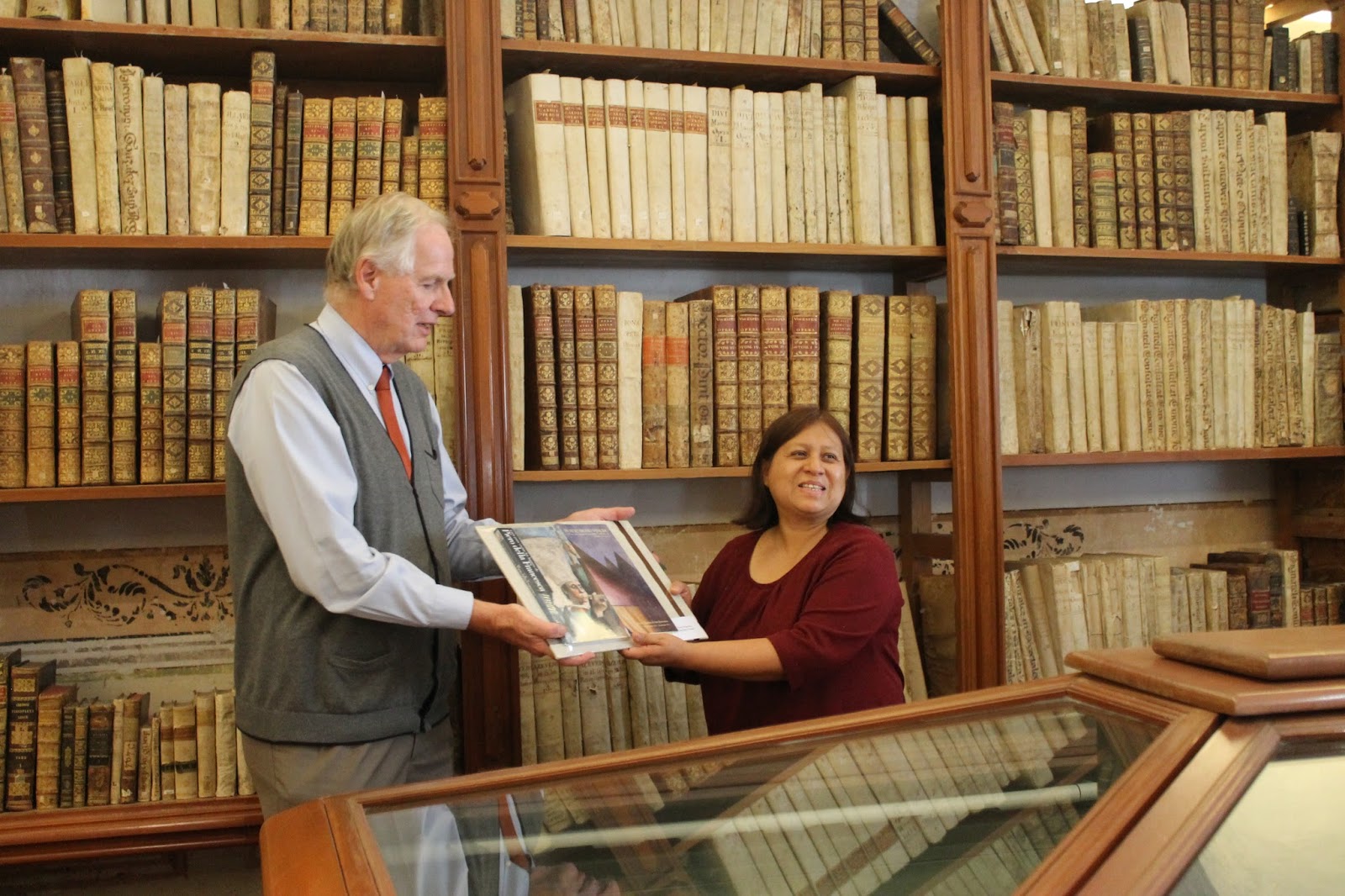
 
The gift of the Book of Piero della Francesca to
 the Old Library of the Museo del Virreinato
(Patrick Kavanagh and Maria Angeles Osorio)
 
You might recall that last year, in the ancient library of the Museum of the Virreinato, we bestowed a copy of the book Piero della Francesca e la Leggenda della Vera Croce, in representation of the authorities of the Cultural Institute of Arezzo.

Heraclius delivers the True Cross back to Jerusalem

Before dawn, the following morning, Constantine gathers his generals together and tells them of his dream. Constantine was not a Christian, but many of his soldiers were. When Constantine told his troops about the Cross, they felt sure that they would win. And after Massentius slipped and fell off the bridge at a critical point of the battle, his troops panicked, retreating in disorder, while Constantine's soldiers fell on them, slaughtering them. Constantine became the sole master of Rome. One year later, in 313 AD, Constantine moved his center of operations up north, to Milano, he published his Edict, the Edict of Milan, giving all members of his empire, freedom of worship.
 
Here on the front bronze doors of Il Duomo di Milano
we can read the text of the Edict of Milan, offering
Freedom of Religious Cult to all men.
 
Constantine's mother, a woman of humble extraction, was a devoted Christian: Elena was he name, and Catholics call her Santa Elena or Saint Helen. Among her many talents and passions, Elena became the founder of Archeology, or at least of Holy Archeology, devoting her fortune and energy, searching out artifacts from the life of Christ. This included her search for the lost Cross of Christ.

The fifth and last part of the saga of the Leggenda takes us another 3 centuries later, when the Eastern Roman Empire, under Heraclius, fight Chosroe, the Persian King who has stolen the Cross of Christ, and desecrated it.
 
After giving so much well-deserved praise to Piero della Francesca's protégé, Luca Signorelli, in recent articles in this blog, I realized that this article is totally devoid of any comments on Piero della Francesca as a painter. I would think that his art in itself is his most elegant eulogy. However there are few aspects of his art, which we are obliged to underline and show how revolutionary Piero della Francesca was in the context of the historical moment of art when he was painting. Painting was for the most part, at his time, ars sacra, works of art depicting divine mysteries, saints, prophets, and the Divinity in reflection, meditation, and in brief, scenes mostly without a great deal of movement.
 
The outlandish headdress is
surely Piero della Francesca's
way of poking a little fun out
of the ridiculous style of his
patrons.
 
Piero della Francesca's painting is all about movement, action, high-impact and dramatic events. An other point I would like is that Piero della Francesca portrays himself, as a lover of horses, the first great equestrian artist. Finally, it seems to me that where in so many painters we find a artist who bends their brush to heap praise on their patrons, it seems that Piero della Francesca ridicules his patrons, in their softest point: their vanity and the fashion of the day. Although Piero paints scenes thousands of years before his time, he dons his personalities in the garb of the quattocentro of Arezzo.  
 
The concept of the True Cross is not exclusive of Arezzo. Carlos V of Germany and I of Spain awarded Hernan Cortes and his royal conquistadores of the defunct Aztec empire a relic of the True Cross, which is still preserved in the Chapel of Our Lady of Guadalupe, in the Church of the True Holy Cross, La Iglesia de la Santa Veracruz.
 

Here in the Chapel of Our Lady
of Guadalupe in the Church of the
Santa Vera Cruz, in downtown
Mexico City we can visit a shrine
 with an authentic relic of the
Cross of Christ

Wednesday, December 9, 2015

Arezzo and the forgotten Legend of the True Cross

Why did Estela and I choose to visit Arezzo?

Skyline of Arezzo, Tuscany, seen from the rooftop of our hotel.
 
One good reason for visiting Arezzo, is that we wanted to visit Roberto Benigni's hometown, and the place where he shot his 1997 feature film La Vita é Bella.

This small Piazza in Arezzo
 with its giant lamppost
was the setting for Benigni's film.

Another good reason for coming here is that like Luca and Prato, Arezzo is a major important city in Tuscany,  without crowds of tourists.

Arezzo is another well kept
secret gem of Tuscany with
its well manicured scrubs
along its boulevards
 
Still another reason for me was that I wanted to get to know the place where Michaelangelo spent time as an infant. Rumor has it that his mother was without milk, and that she had to recur to a wet nurse. The family of the wet nurse worked and lived on the outskirts of Arezzo,  in the marble quarry.

Michelangelo in Raffaello's
Scuola di Atene, with his
sulking face and broken nose,
Stanze di Raffaello, Vatican Museum
 
As an adult, when questioned about why he liked sculpture over painting, he would reminisce about his wet nurse, claiming, possibly in jest, but probably with that accustomed soar face (that Raffaello mimicked so cleverly in his Scuola di Atene, as you can see above),  that as a baby he sucked on milk mixed with marble dust.

A more hedonistic reason for visiting Arezzo, is its fine cuisine of country fair, such as roasted wild game, cooked slowly over an open wood-burning hearth.

The warmth of an open fire, in Arezzo

To meander down the fair alleyways of Arezzo is a very pleasant experience, where you might see things from the past long-since disappeared from the rest of Italy. Such was our experience as we saw this vintage red Fiat 500. As  you see, Arezzo feels comfortable with its past and present coexisting in harmony.

A well preserved classic Fiat 500


But really,  why did Estela and I decide to cut short a delightful afternoon in Florence, to drive down the snowy hills of the Apennine to Arezzo?
 
The fog-ridden road down the
snowy Apennine hill country.
 
Estela was easy to motivate.  "Did you know that the city where more jewelry is designed and made in Italy is Arezzo?" I asked her. "All kinds," I continued,  "from cute, inexpensive trinkets,  up unto the most sophisticated designer jewelry.".
Rosita, my sister-in-law and
Estela, my wife, with the
same lamppost but with a view
of a small street in Arezzo
with great shopping opportunities 

Personally, I was looking for something more sublime.  I wanted to track down an ancient legend: "la leggenda della vera croce" as "the legend of the true Cross" is called here, and that legend took us to the masterpiece of Piero della Francesca, in the Basilica di San Francesco,  in Arezzo. At the same time,  I wanted to visit the house of the greatest art expert of all times, Giorgio Vasari, author of  Le Vite de' più eccellenti architetti, pittori e scultori Italiani (The Lives of the Most Excellent Italian Architects,  Painters and Sculpturers,  1550) wasn't at home to greet us personally, but Estela and I enjoyed being there, as many of his patrons and friends had before us, as if we were his personal guests. But first things first: off we go in track of our Legend of the True Cross. 

Here I was at the threshold of
the unpretentious façade of the
Church  of San Francesco, in pursuit
of the Legend of the True Cross
 
To visit Piero della Francesca's series on the Leggenda della Vera Croce is no easy task. Great efforts are made to keep this capolavoro or masterpiece of the quattrocento intact. Humidity controls. Light controls. Flash not permitted. Photography not permitted. Filming not permitted. Crowds not permitted. Small groups by reservations only. If you wish to make a reservation yourself, use your internet explorer and go to:
 
 
8 Euros per adult for a swift 10 minute peek.
 
I bid thee all farewell this evening, and take a needed rest and recommend the same to you all, because if you are will to accompany us, albeit cybernetically, we will recommence this adventure in our next post tomorrow:
Piero della Francesca and the Legend of the True Cross.


Monday, December 7, 2015

Orvieto and the Apocalypses according to Luca Signorelli

This is the last and most formidable part of our report on Il Duomo di Orvieto: the Apocalypses Series of Affreschi, initiated by Beato Angelico and executed by Luca Signorelli, in the Cappella Nuova or Cappella di San Brizio. 

Satan counseling the Antichrist

The affreschi of La Cappella di San Brizio follow a narrative line that includes four terrifying chapters:
  • The Coming of the Antichrist,
  • The End of the World,
  • The Rising of the Dead, and
  • The Last Judgment
The fall of the Antichrist

Anguish at the End of the World

When I saw the Cappella di San Brizio for the first time, I made an enormous miscalculation of when Luca Signorelli performed this masterpiece, coming to the incorrect assumption that it had been executed sometime in the mid-16th Century, based on the style.

The looks of fear and uncertainty at the End of the World

I had ignorantly assumed that Luca had received strong influence from Michelangelo, Raffaello and Giuglio Romano.

The Rising of the Dead

After I starting reading Giorgio Vasari famous work (Vite de' più eccellenti architetti, pittori, et scultori italiani), I realized that this Luca Signorelli was working on the death of Moises on the walls of the Sistine Chapel almost a quarter of a century prior to Pope Julius II giving his first assignment to Michelangelo to paint the vault.

Christ Supreme Judge

At this point of time (1480), no one had ever painted the human body with such grace as Luca Signorelli, and no one had ever handled the feelings of human dread with such intensity. At several points of the Chapel of San Brizio, the figures seems to come out of the affreschi and into the chapel.
 
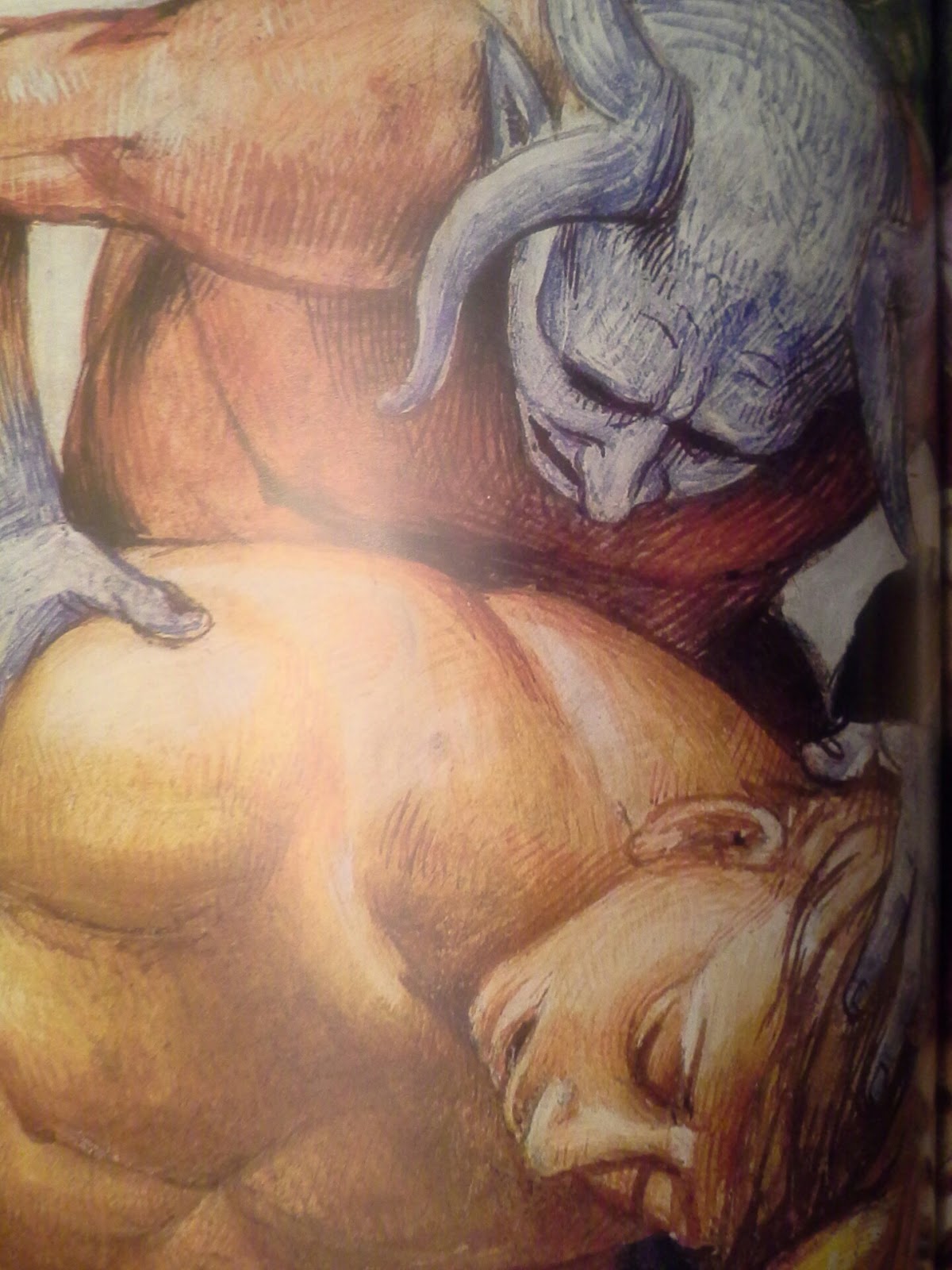
Demons carry away the Damned
On a personal note, I feel that these affreschi, after 500 years, carry the strength and persuasion for anyone with doubts about their lives and conduct, to rethink their behavior, if not for love of God, than at least for the dread of eternal damnation. You might want to create a fuller atmosphere for your reflection, listening to the ancient Latin hymn which deal with the prophecy of the last days: Dies Irae: Dies iræ, dies illa, Solvet sæclum in favilla, Teste David cum Sibylla ! Quantus tremor est futurus, quando judex est venturus, cuncta stricte discussurus ! ("Days of wrath, those Days, Centuries are dissolved in dust, as David with the Sibyl are witnesses, How Great will be our terror in the Future, when the Judge comes, with his strict discourse.")

Those who have lived a life as slaves of their passions,
perish at the hands of the merciless.
 
Luca Signorelli however is not just a painter aimed at instilling fear. His dealing with love, with the eternal paradise and with the crowning of the saints is as attractive as his portrayal of damnation is foreboding.
The crowning of the Saints
 
The most dreadful aspect of damnation is the decision between right and wrong, heaven and hell, is of our own free will, of our own doing, or of our own undoing, and this aspect of remorse and despair is wonderfully portrayed by Luca Signorelli. He has added the visual content for Dante Alighieri's Divina Commedia.

The crowning of the Saints

Who was Luca Signorelli? As Giorgio Vasari tells us, he was born in Cortona, and he studied under Piero della Francesca. We know a considerable amount about his work, but very little of his personal life. So what can we learn know about Luca by looking at his affreschi? He was first and foremost, a master at sketching. His brushstrokes are long, fearless and without trepidation. reminiscent of Giotto, but with a handling of chiaroscuro, of perspective, beyond any master of the quattrocento before Sandro Botticelli. His long fiery brushstokes full of contempt for the demons as if he were listening to Richard Wagner's Flight of the Walkyries, while his drawing of saints and angels are done with patience and delicate care for every lock of their hair and every tone of their complexion. His freedom of stroke and earthy tones are reminiscent of the 20th century Mexican muralists, like Orozco and Diego Rivera, and their feeling of tumultuous chaos.

The Apocalypses by Jose Clemente Orozco on the vault of the Jesus Nazareno Church, Mexico
Special note. Unless where otherwise stated, every photograph in my blog, are photographs which I have taken personally. However, in this case, it is strictly prohibited to take pictures in the Cappella di San Brizio, and I, as a lover of art, try to always show respect where I am indicated of these prohibitions. So for this picture, I took pictures from the book, Mirabilia, Il Duomo di Orvieto, e il Giudizio Universale di Luca Signorelli, M Mirabilia, Orvieto,  Quarta Edizione, 2013, to which I render credit as a source of my own resized photographs.


Sunday, December 6, 2015

The most beautiful Gothic facade in Umbria

The facade of Santa Maria Assunta,  otherwise known as il Duomo di Orvieto,  has a magnetic attraction, pulling our sight upward, in swirls around the pillars,  the statues and the ubiquitous blue and golden tiles, into a central vortex,  or "rose", and in its center is a bust depicting God the Father. 

The "Rose" is at the top center of the Façade of il Duomo di Orvieto
 
The "rose" has petals of stained-glass windows, outlined between columns with Salomonic swirls,  and framed in a square with four Fathers of the Church (Saints Jerome,  Augustin, Gregory the Great and Ambrose) depicted in mosaics in each corner of the frame.

The 12 apostles form a row of full-body sculptures at the top of the Façade.
 
Enhancing the perimeter of the frame, are 52 marble busts of saints, while one each side there are three pairs of full-body sculptures of the most outstanding personalities of the Old Testament,  and on top of the frame a series of twelve full-body sculptures of the apostles.
 
God the Father creates Eve, using the rib of Adam

The façade is supported by four major columns,  each one decorated with marble friezes, depicting major events in the Bible.

The Archangel blands his fiery sword as Adam and Eve leave Paradise.
 
The first column on the left displays the major events of God's Creation as related in the Book of Genesis.
Cain slays Abel, the world's first fratricide.

The fourth or final column on the right corner shows the Last Judgment,  as revealed in the Book of the Apocalypse.
The crowds full of despair are condemned to Eternal Damnation. 

To view the façade, and specifically the columns of the Cathedral, is like reading a book,  from left to right,  and from top to bottom. Over the centuries,  the façade of a Basilica,  a Church or a Cathedral was increasingly used as a means of communication,  of evangelization,  in a period when illiteracy was more the rule than the exception. Before the invention of the printing press, architecture, sculpture, painting, song and plays were the more common means of communication of messages to the masses. Bonum facendum, malum vitandum ("Do good, avoid evil!") was the message, and the message was not subtle.

The Assumption of the Blessed Virgin into Heaven is the topic of the above Mosaic
 
The façade of Il Duomo di Orvieto has major mosaics: three above the doors, three in the middle level alongside the "rose", and three at the top level. At the bottom level, from left to right, we have the Baptism of Christ, then above the main door the glorious Assumption of Mary into Heaven, and over the right door, the Birth of Mary. The predominate position of the mosaic of the Assumption is due to the fact that this Cathedral is dedicated to Santa Maria Assunta, that is, to Holy Mary Assumed into Heaven. For those not familiar with Catholic Faith and Doctrine, it is believed that Christ, died on the Cross, rose on the third day, the Resurrection, and after forty days, ascended into heaven, on Ascension Thursday. On the other hand, His Mother, Mary, born Immaculate, without the stain of original sin, did not die, but fell into a dormition or a deep sleep, and was assumed into Heaven, on the Assumption. 

Above the Assumption Mosaic, we can find an arched passageway, hallmark of Gothic architecture. The purpose of those arched passageways during the late medieval and renaissance periods was to act as a platform or stage for religious plays, particularly, Nativity plays and Passion plays.

Saturday, December 5, 2015

"Tantum ergo" and a well guarded Jewel of Beauty in Umbria

Many a day of our lives, we, Estela, my wife and I, have spent, stumbling along roads of Christendom, finding jewels of great splendor and beauty, hitherto unknown to us.

The façade of the Duomo di Orvieto

When I hear "Tantum, Ergo", a beautiful piece of Gregorian Chant, composed by the Dominican Monk,  father of Scolastical Theology and author of the Summa Theologica, Thomas Aquinas, I realize that I am in the presence of a melodious, but clear and easily understandable introduction to the Mystery of the Eucharist as understood by Catholics for centuries.
 
The main entrance and bronze doors of Il Duomo di Orvieto

This Mystery of the Eucarist includes the philosophical and theological concept of the Transubstantiation.


The cast bronze doors portray the 7 acts of corporal mercy.


Back in my days of formation in a Catholic Seminary, we would go to bed at 9:00 pm (because we would wake up every morning and take a shower at 4:45am). On Thursday evenings,  we would rise again, at 10:40, and we get dressed again, and go down to our Chapel,  starting our "Holy Hour" at 11:00 pm. The Holy Sacrament, in the form of a host, is removed from the tabernacle, and set in the Monstrance for everyone in the Chapel to behold and to adore. The Holy Hour is intended as an act of expiation,  and thus, an act of Love towards Jesus Christ. (The very idea of expiation in our hedonistic culture today is as foreign to us as it is misunderstood, and often confused with masochism.) At the end of the hour of meditation,  we would chant Tantum Ergo, and I can still remember the smell of the incense we offered up to the Corpus Domini in the closing moments of the adoration.

The four columns of the façade reveal the highlights of the Old and New Testament


The right corner column of the façade offers a synopsis of the Last Judgment.

The bottom corner of the right-hand column of the façade gives a terrific view of Hell.

Tantum ergo Sacramentum
Veneremur cernui:
Et antiquum documentum
Novo cedat ritui:
Præstet fides supplementum
Sensuum defectui.
Genitori, Genitoque
Laus et jubilatio,
Salus, honor, virtus quoque
Sit et benedictio:
Procedenti ab utroque
Compar sit laudatio.
Amen.
Right hand side view of Il Duomo with its white and green ribs of marble.

Hence so great a Sacrament
Let us venerate with heads bowed
And let the old practice
Give way to the new rite;
Let faith provide a supplement
For the failure of the senses.
To the Begetter and the Begotten,
Be praise and jubilation,
Hail,  honor, virtue also,
And blessing too:
To the One proceeding from Both
Let there be equal praise.
Amen.

So far, I write of Theology and Liturgy, but these are very abstract and distant.  Now let me tell you a story about a priest, who lived in Bohemia,  and felt profound doubts about the Transubstatiation of the Body and Blood of Christ during the celebration of Mass. Suitably,  his name was Peter, Peter of Prague. He was on a pilgrimage to Rome,  and as he was saying Mass,  in the Church of Santa Caterina close to the shores of Lake Bolsena, he was assaulted by his accustomed doubts, when suddenly  the consecrated Host started to bleed human blood, pouring out on the corporal and staining the stone altar.

Interior view, facing the back, with the Gothic Rose Window lighting up the main aisle

Possibly you have visited Le Stanze di Raphaello in the Vatican Museums, and you have seen the gigantic wall affresco painting, illustrating this miracle.
The Miracle of Bolsena alfresco in the Stanza Eliodoro of the Vatican Museums
This affresco was painted during a moment of strong contention between Catholic Theologians, that defended the authenticity of the Eucharist,  and many Protestant Theologians, that thought differently. 
The altar of the Apse of Il Duomo di Orvieto

We seem to have slid back away from stories, and back into the quagmire of Theological discussion,  far from where a road took Estela, my children and me,  one early Summer afternoon.
La Cappella del Corportale
 
It was July, and we had parted Florence after breakfast,  all six of us driving south on the Autostrada del Sole. The day was warm and sunny,  and the fields were glimmering with golden wheat. We had been driving almost 2 hours, when Estela saw an exit sign:  "Look, just like the white wine you like so much: This town has the same name.  Maybe it comes from here? " Then my smallest child remarked: "It's 12:30 already, Dad! Remember that if we don't find a trattoria before 1:30 in these small cities here in Italy, that they don't want to give us a table!" So I gave up hope of an early afternoon arrival to Rome,  and took the exit. 20 minutes later we were as close as we could possibly get to the Piazza del Duomo, and we parked our van. When you are driving with a young family,  the first thing that happens when you park,  is that all the doors fly open everywhere,  and everyone starts looking for "la toilette". So I walked up to La Piazza,  went into il Caffè or Bar,  and asked for an espresso, while all my children used the bathroom. After my first sip of a delicious espresso,  I turned around to behold what many consider to be the most beautiful churches in Christendom: il Duomo di Orvieto. 

I could see that the ushers were starting to close the doors of the church,  so we hurried out of the bar, across the Piazza, and into one of the still opened front doors.
La Cappella del Corporale

Let's take a pause: we were facing for our first time,  the facciata or façade of il Duomo. Personally,  I believe that no other façade includes a more beautiful harmony of tile, sculpture and marble, a splendid sample of Italian Gothic architecture,  shining with a blinding glare, as we tried to escape the scrutiny of the ushers. 

Once inside,  we continued to scramble out of the sight of the ushers,  sneaking down the darker side aisle,  although thanks to its enormous central stained-glass rose window in the middle of the façade,  the interior is never dark during daylight hours.  I whispered that in the side chapel were the evidence of the famous miracle of Father Peter of Prague. So when we came up to the transept of the Cathedral,  and took a turn, a right turn, believing that we were about to enter the Chapel of the Corporal, but which turned out to be the wrong turn. What we saw was both beautiful, unexpected, frightening and breathtaking for my children and for me. We had entered into the Chapel of the Madonna of Saint Brizio.

As we looked up the walls of the chapel,  we saw corpses crawling out of the ground,  a sky painted a foreboding lead-blue tone,  as if sunlight would never return,  Christ and his Blessed Mother in the middle,  while demons hurry to carry off the dammed. We had entered into the chapel, and we are bewildered with the scenes of terror. Without warning, we entered into the world of Luca Signorelli, a world that deserves a separate article in our blog, which I promise you soon.